

Science & Tech · Science & Environment · 4 hrs ago
New Algorithm Finds Four-Color Map Solutions Faster
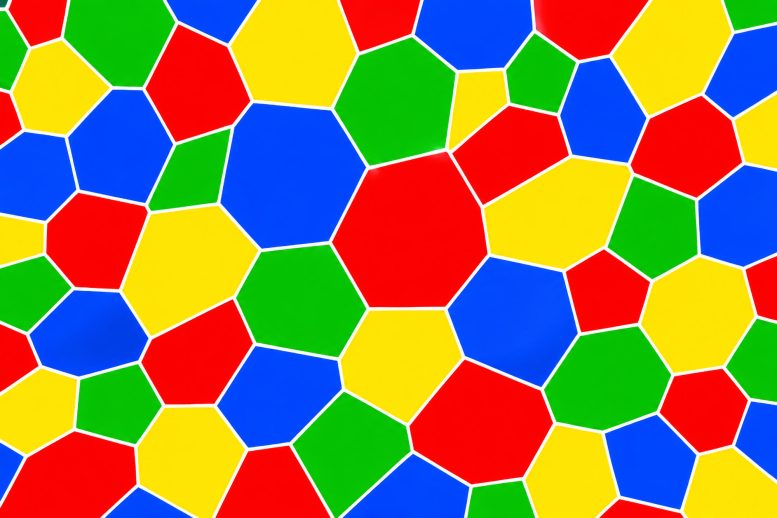
An international team of mathematicians developed a faster way to color maps using four colors.
The work concerns the Four Color Theorem, which says any flat map can be colored so that neighboring regions have different colors, using no more than four colors.
Mathematicians proved the theorem in 1976, but finding a coloring for large maps remained computationally demanding.
The team found many more useful patterns in map-based graphs that help simplify the coloring task.
Their algorithm takes linear rather than quadratic time: a map with ten times as many regions takes about ten times longer to process, instead of about 100 times longer.
The research was presented at FOCS’26, where its first part received the Best Paper Award, and the discovery marks the first major breakthrough on the problem in nearly 30 years.

An international team of mathematicians has developed a faster algorithm for finding four-color solutions to maps.
The method uses many useful arrangements in map-related graphs, rather than relying on only one starting point.
The researchers say the algorithm improves the computation from quadratic time to linear time.
The work is the first major breakthrough on the problem in nearly 30 years.
The first part of the research paper was presented at FOCS’26 and received the Best Paper Award.
- Who
- An international team including Carsten Thomassen, Ken-ichi Kawarabayashi, Mikkel Thorup and Bojan Mohar.
- What
- The team developed a faster algorithm for finding four-color map solutions.
- When
- The first part of the research was presented at FOCS’26. The article was published on 2026-11-26.
- Where
- The research was presented at FOCS’26; the article does not state where the conference was held.
- Why
- The algorithm aims to find four-color solutions more efficiently, especially for large maps.
This story does not have two clearly opposing sides.
English mathematician Francis Guthrie noticed that four colors were enough to color a map of England’s counties without neighboring counties sharing a color.
Mathematicians succeeded in proving the Four Color Theorem with a proof that relied heavily on computer calculations.
A more accessible proof of the theorem followed.
Thorup and his colleagues worked on finding the faster solution.
The first part of the research paper was presented and received the Best Paper Award.
- Team members
- Carsten Thomassen, Ken-ichi Kawarabayashi, Mikkel Thorup and Bojan Mohar
- Algorithm improvement
- Quadratic time to linear time
- Map-size example
- Ten times as many regions means about ten times the computation time
- Research history
- The theorem was proved in 1976
- Conference recognition
- Best Paper Award at FOCS’26
What people are saying
The previous proofs showed that it is always possible to color a map using four colors. But they are not very good at actually finding the colors for each individual region on a map. The new algorithm is efficient and provides a much faster way of coloring.
Think of reducible configurations as handles you can grab hold on to start four coloring. We show that graphs do not contain just one handle, but an astonishing number of them. Nobody knew that before.
We have gone from what mathematicians call quadratic time to linear time. This means that if a map contains ten times as many regions, the computation only becomes about ten times slower. With the previous algorithm, it would have become about 100 times slower.