

Science & Tech · Space · 4 hrs ago
Hubble Reveals a Vast Dust Tail Around the Young Star Beta Pictoris
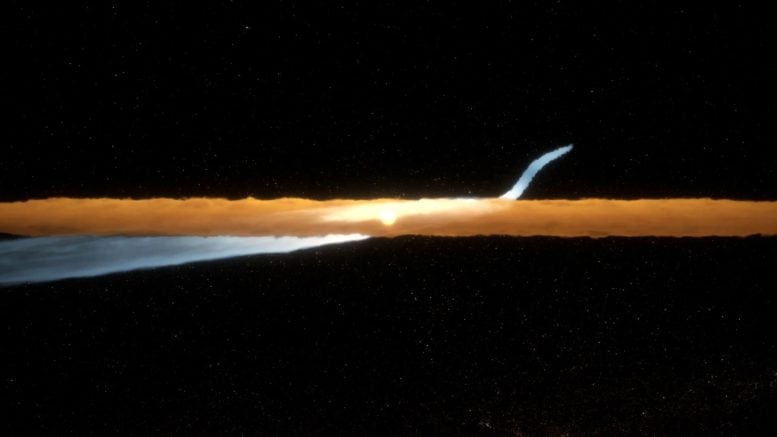
The Hubble Space Telescope has detected the Cat’s Tail in visible light around Beta Pictoris, a young star system 63 light-years from Earth.
The dust structure stretches up to 1,000 astronomical units, or about 93 billion miles.
The tail was first seen in infrared observations by the James Webb Space Telescope, but it had not shown up in visible-light images.
Researchers think its carbon-rich dust absorbs visible light, helping explain why it was hard to see.
Beta Pictoris is about 20 million years old, and its surrounding debris disk holds material left over from planet formation.
The tail may be debris from a collision between large bodies, though scientists do not yet know exactly how its unusually porous, tiny dust grains formed.
Hubble images and observations collected over more than 14 years are helping researchers study the tail’s composition, shape and possible origins.

Hubble observations have revealed the Cat’s Tail, a vast dust structure around the young star Beta Pictoris, in visible light for the first time.
The structure extends as much as 1,000 astronomical units, or about 93 billion miles.
The tail was first detected in infrared observations from the James Webb Space Telescope but had not been seen at shorter wavelengths.
Researchers say its dust appears to be mostly carbon-based material that absorbs visible light.
The feature may be debris from a collision between large bodies, though how its tiny, porous dust grains formed remains uncertain.
- Who
- Astronomers studying Beta Pictoris, led by University of Arizona doctoral student Arin Avsar.
- What
- Hubble observations revealed the Cat’s Tail dust structure in visible light for the first time.
- When
- The article was published on 2026-11-02; the observations span more than 14 years.
- Where
- Around Beta Pictoris, 63 light-years from Earth in the constellation Pictor.
- Why
- Researchers are investigating the structure’s composition, geometry and possible origins; it may be debris from a collision between large bodies.
This story does not have two clearly opposing sides.
The Cat’s Tail was discovered in infrared observations from the James Webb Space Telescope.
Astronomers gathered observations used to investigate the structure.
SciTechDaily reported that Hubble observations had revealed the Cat’s Tail in visible light.
- Structure
- Cat’s Tail
- Maximum extent
- 1,000 astronomical units, about 93 billion miles
- Distance from Earth
- 63 light-years
- Star system age
- Roughly 20 million years
- Dust composition
- Mostly organic refractory material, described as heavily carbon-based
- Observation tools
- Hubble Space Telescope and James Webb Space Telescope
What people are saying
Oddly, this feature had previously only been seen with the James Webb Space Telescope, which detects infrared light, but remained invisible at shorter wavelengths, which has puzzled the community for a while.
We think the Cat’s Tail has eluded our observations in visible light until now because of what it’s made of
It consists almost entirely of what we call organic refractory material, which is heavily carbon-based. These long chains of carbon atoms absorb visible light, so they’re quite black.
The Cat’s Tail is thought to be the aftermath of a collision between large bodies – think something like Pluto,