

Science & Tech · Science & Environment · 3 hrs ago
Map identifies where ancient Martian rain may have delivered life-related chemicals
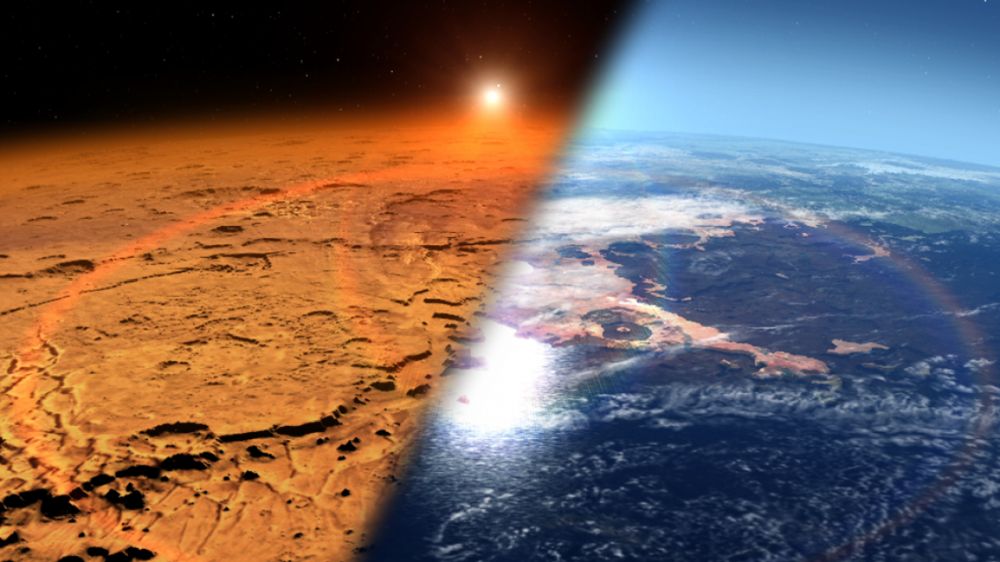
Researchers mapped where ancient rain may have deposited formaldehyde on Mars billions of years ago.
Mars was warmer and wetter between 3.5 and 4.1 billion years ago, raising the possibility that it could have supported microbial life.
Formaldehyde can help produce sugars and amino acids, which are building blocks for more complex chemistry associated with life.
The team's simulations suggest some areas, including the Tharsis and Elysium regions, received about ten times the planet-wide average.
The map does not show how much formaldehyde remains today or prove that life existed on Mars.
It could help choose future mission landing sites where evidence of past life may be preserved.
Researchers say future observations can test whether areas with more formaldehyde were also favorable for early life-related chemistry.

Scientists led by the Institute of Science Tokyo mapped places where ancient Martian rain may have delivered formaldehyde to the surface.
The molecule can help drive chemical reactions that produce sugars, amino acids and other complex organic compounds.
The team’s simulations suggest mountainous regions including Tharsis and Elysium received about ten times the global average.
The map could help researchers select targets for future Mars missions seeking signs of past life.
The study does not show how much formaldehyde, if any, remains on Mars today.
- Who
- A research team led by scientists from the Institute of Science Tokyo, including Dr. Shungo Koyama.
- What
- The team created a map of locations where ancient rain may have delivered formaldehyde, a molecule linked to life-related chemistry.
- When
- The study modeled conditions in the late Noachian and early Hesperian, billions of years ago.
- Where
- Mars, with mountainous regions including Tharsis and Elysium among the mapped hotspots.
- Why
- To investigate where formaldehyde may have supported prebiotic chemistry and help guide future Mars missions.
This story does not have two clearly opposing sides.
Mars was warmer and wetter during the Noachian and Hesperian eras.
Researchers simulated Martian conditions to estimate where formaldehyde formed and fell in rain.
Universe Today published an account of the research and its map.
- Molecule
- Formaldehyde (H₂CO)
- Hotspots
- Tharsis and Elysium
- Estimated rainfall delivery
- About ten times the global average in some mountainous regions
- Publication
- The Planetary Science Journal
- Study lead
- Dr. Shungo Koyama, Institute of Science Tokyo and Tohoku University
What people are saying
By comparing our map with findings from rovers, we can begin to test whether places that received more H₂CO were also more favorable for early life-related chemistry.
If future observations confirm this relationship, our map could help identify promising targets for future Mars missions.