

Science & Tech · Space · 11 hrs ago
Unusual Mars Gas Detections Near Alba Mons May Point to Magma
Mars is widely believed to have become volcanically dormant as its interior cooled, though spacecraft have found signs of activity such as marsquakes.
The ExoMars Trace Gas Orbiter has detected hydrochloric acid in Mars’ atmosphere before, mostly during the warmer season when sunlight can drive atmospheric processes.
A new study reports detections during the colder season, when the gas is otherwise absent.
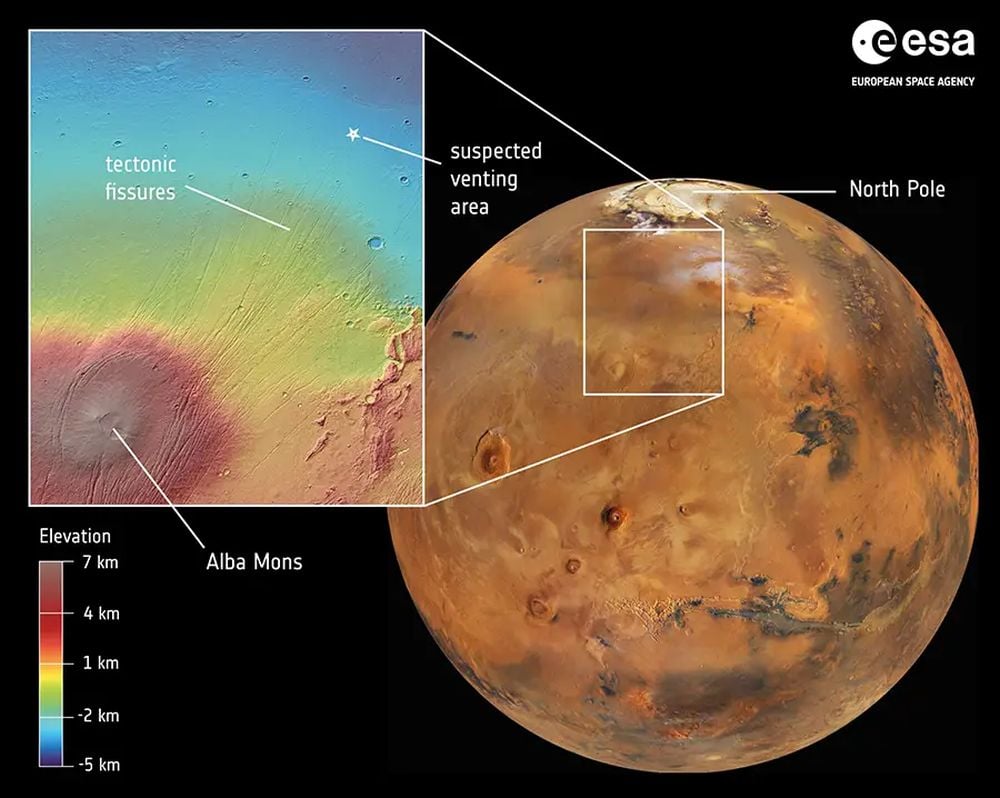
The detections were concentrated near Alba Mons, a vast volcano in the Tharsis region.
The researchers say the gas could seep from magma chambers that may still be active, but the observations do not prove that an eruption is happening.
Understanding whether Mars still has molten material underground could help explain the planet’s interior and its volcanic history.
No eruption has been observed, so researchers must rely on indirect evidence to assess Mars’ present activity.

Researchers report hydrochloric acid detections near the Martian volcano Alba Mons during a season when the gas had otherwise not been detected.
The study says the detections could be a sign of magma chambers or other ongoing igneous activity.
Earlier detections by the ExoMars Trace Gas Orbiter were largely associated with the warmer perihelion season.
The researchers say the localized detections occurred during the colder aphelion season and were not explained by observed atmospheric conditions and models.
Mars is widely considered volcanically dormant, but evidence of possible recent activity has accumulated.
- Who
- A research team led by Alexander Trokhimovskiy of the Space Research Institute at the Russian Academy of Sciences.
- What
- The team reported hydrochloric acid detections near Alba Mons. They say the gas could indicate igneous activity.
- When
- During the cold aphelion season. The article was published on November 9, 2026.
- Where
- In Mars’ atmosphere near Alba Mons, in the Tharsis region.
- Why
- The detections may offer evidence of active magma chambers or other ongoing activity beneath Mars’ surface.
This story does not have two clearly opposing sides.
The Trace Gas Orbiter detected widespread hydrochloric acid at parts-per-billion levels, initially only during perihelion.
Researchers reported hydrochloric acid detections isolated near Alba Mons.
Universe Today published its article about the findings.
- Gas detected
- Hydrochloric acid (HCl)
- Location
- Alba Mons region, Mars
- Season
- Cold aphelion
- Study lead author
- Alexander Trokhimovskiy
- Previous Marsquake detections
- More than 1,300 by InSight
What people are saying
While sulfur dioxide, so far undetected, could testify to ongoing eruptive activity, evidence of active magma chambers may be better identified by seepage of halogen gases, such as hydrogen chloride (HCl)
Here, we report HCl detections during the cold aphelion season that are isolated in the Alba Mons region.