

Health · Medical Research · 15 hrs ago
Brief high-fat diet heightened skin inflammation in mice
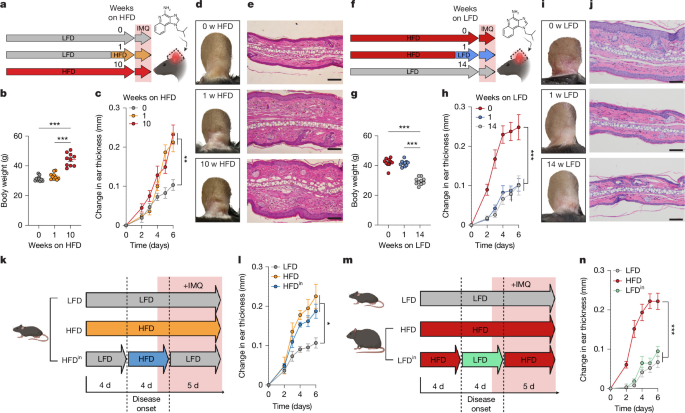
A UC San Francisco team found that short-term diet changed immune responses in mice exposed to a cream that causes skin inflammation.
Mice given high-fat food for just a few days developed stronger inflammation than mice eating low-fat food.
The effect was not explained by body weight: normal-weight mice on high-fat food reacted strongly, while obese mice switched to low-fat food had milder reactions.
The high-fat diet intensified the skin reaction, and the study also found that a brief low-fat diet could restrain it in obese mice.
After the inflammation settled and the mice returned to low-fat food, their skin remained primed for a stronger later response to the same irritant.
The researchers linked this lasting effect to immune cells that entered the skin during inflammation and memory T cells that remained there.
The findings suggest diet can quickly shape inflammatory memory, but the experiments were in mice, and the researchers said mouse diets do not map neatly onto human eating habits.

A brief high-fat diet intensified skin inflammation in mice exposed to an irritating cream, a study by a University of California, San Francisco team found.
The mice’s response was stronger after a short dietary change, even when they were not obese.
After mice returned to a low-fat diet and their inflammation subsided, a second exposure triggered an outsized response.
Researchers linked the lasting effect to immune cells that remained in the affected skin.
The study, published in Nature, also found heightened inflammation in the lungs after a few days of high-fat food.
- Who
- Researchers at the University of California, San Francisco, including Sagar Bapat and Zewen “Owen” Jiang.
- What
- The team found that brief high-fat feeding worsened mice’s skin inflammation and left the tissue more responsive to a later irritation.
- When
- The study appeared in Nature on October 28, 2026.
- Where
- In experiments on mice; the research team was at the University of California, San Francisco.
- Why
- Researchers tested whether diet itself, rather than body weight alone, could affect inflammatory responses.
This story does not have two clearly opposing sides.
In one experiment, researchers applied imiquimod cream to mice that had been switched from low-fat to high-fat food.
Mice that had returned to a low-fat diet received a second dose of imiquimod, which triggered an outsized response.
The study appeared in Nature.
- Diet switch
- Four days of high-fat food was enough to trigger an over-active immune response in one experiment.
- Inflammation trigger
- Imiquimod cream was applied to one ear of each mouse.
- Diet composition
- The Nature study used a high-fat diet with 60% of calories from fat and a low-fat diet with 10%.
- Persistent response
- Memory T cells remained in the affected ear after inflammation subsided.
- Additional tissue
- Researchers also found heightened irritation-related inflammation in the lungs.
3 sources
What people are saying
Breakfast, lunch, dinner - they all can have a tremendous and rapid impact on the immune system.
For many years, we've known that obesity is tied to more severe inflammation. But we wanted to know whether it was the extra weight or simply the bad diet that was driving the stronger response.
Diet, exercise, sleep - they could all shape immune health in ways we don't yet appreciate.