

Science & Tech · Space · 8 hrs ago
Galileo’s Amalthea flyby found a moon less dense than water
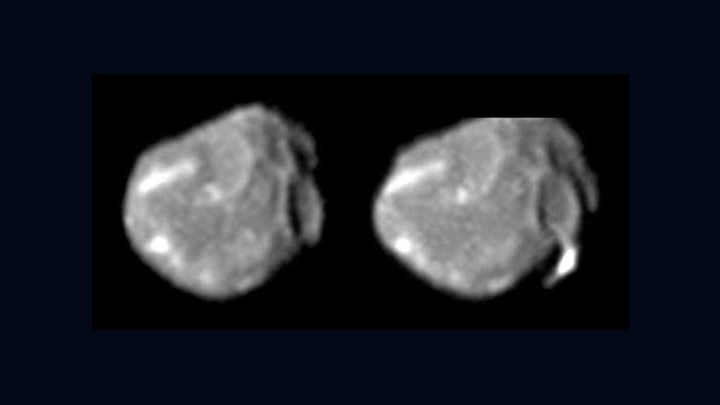
On Nov.
5, 2002, NASA’s Galileo spacecraft flew past Jupiter’s moon Amalthea during its final close visit to one of Jupiter’s moons.
Amalthea is a small, red moon that orbits close to Jupiter, where intense radiation can threaten spacecraft.
Galileo passed within 99 miles of the moon, collecting data as it flew by.
The probe soon entered safe mode, but NASA restored it to operation.
The data showed Amalthea is less dense than water, suggesting it contains water ice and rock with many gaps inside.
That finding helped scientists understand the unusual makeup of a moon that also produces more heat than it receives from the Sun.
Galileo later ended its mission in Jupiter’s atmosphere, crashing there on Sept.
21, 2005.

NASA’s Galileo spacecraft found that Jupiter’s moon Amalthea is less dense than water.
Galileo made its final flyby of a Jupiter moon when it passed Amalthea on Nov. 5, 2002.
The spacecraft flew within 99 miles of the moon.
NASA announced the density finding in May 2005, based on Galileo data.
Amalthea’s low density suggests it contains substantial water ice and is porous.
- Who
- NASA’s Galileo spacecraft studied Amalthea.
- What
- The flyby data showed that Amalthea is less dense than water.
- When
- The flyby took place on Nov. 5, 2002. NASA announced the finding in May 2005.
- Where
- Amalthea, a moon of Jupiter.
- Why
- The flyby gathered data about the moon’s properties, including its density.
This story does not have two clearly opposing sides.
Galileo flew within 99 miles of Amalthea.
NASA announced that Galileo data showed Amalthea is less dense than water.
Galileo crashed into Jupiter’s atmosphere.
- Flyby date
- Nov. 5, 2002
- Closest approach
- 99 miles from Amalthea
- Density finding
- Less dense than water
- Announcement
- May 2005
- Galileo’s end
- Crashed into Jupiter on Sept. 21, 2005
What people are saying
Its density is well below that of water ice, and even with substantial porosity, Amalthea probably contains a lot of water ice, as well as rock.
Scientists studying data from NASA's Galileo spacecraft have found that Jupiter's moon Amalthea is a pile of icy rubble less dense than water