

Science & Tech · Space · 7 hrs ago
New images reveal detailed knots in Pa 30’s supernova debris
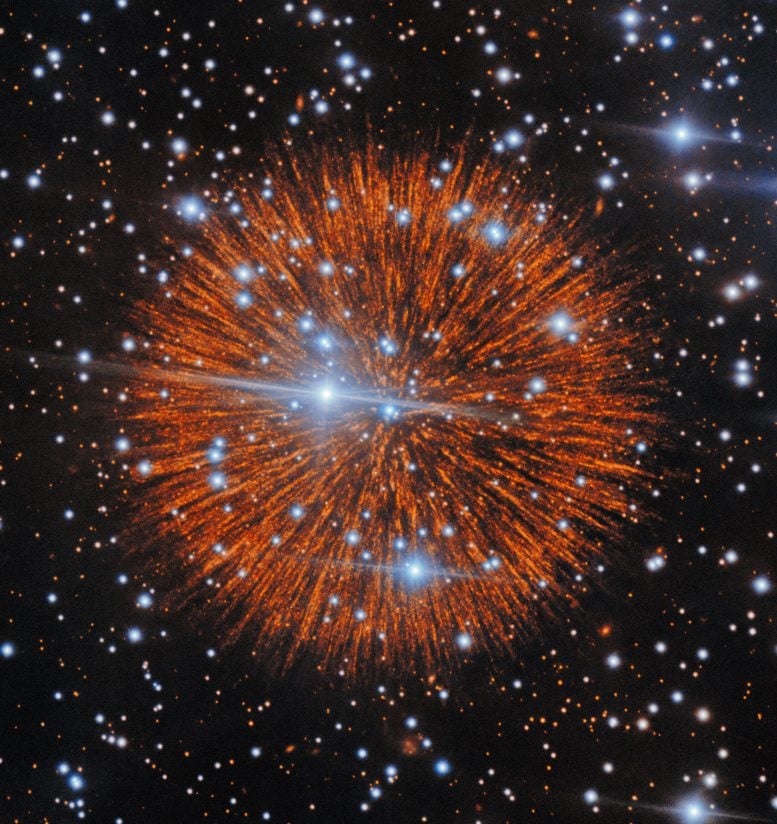
Astronomers used the Gemini North telescope in Hawaii to capture sharp new images of Pa 30, a cloud of debris around a star that survived an explosion.
Pa 30 is about 7,500 light-years from Earth, relatively close by astronomical standards.
Researchers linked it to a supernova seen in 1181, making it one of five pre-telescope-era supernovae whose remnants had long been unidentified.
The new images reveal roughly ten times as many gas filaments as earlier images, showing that the cloud’s streaks are made of chains of small knots.
The explosion was a rare Type Iax supernova, an incomplete stellar explosion that left a star alive inside the debris.
Studying Pa 30 could help astronomers find other explosions that leave surviving stars, and researchers say they are keen to model the knots they have now resolved.

New images from the Gemini North telescope show Pa 30’s supernova debris as chains of gas knots.
The images resolve roughly ten times as many gas filaments as previous images.
Pa 30 is linked to a supernova witnessed in 1181, and the star at its center survived the explosion.
Researchers say the remnant could help guide searches for other stellar explosions that left surviving stars.
The findings were published in The Astrophysical Journal.
- Who
- An international research team co-led by Tim Cunningham and Ilaria Caiazzo.
- What
- The team captured detailed images of Pa 30, revealing chains of gas knots in its debris.
- When
- The supernova was witnessed in 1181; the study was published in 2026.
- Where
- Pa 30 is about 7,500 light-years from Earth. The images were captured with the Gemini North telescope on Mauna Kea, Hawaii.
- Why
- Researchers studied the remnant to examine its debris and inform searches for other explosions that left surviving stars.
This story does not have two clearly opposing sides.
A supernova later associated with Pa 30 was witnessed.
A citizen scientist identified Pa 30.
Astronomers connected Pa 30 to the supernova witnessed in 1181.
SciTechDaily reported on the study and its new images.
- Distance from Earth
- About 7,500 light-years
- Telescope
- Gemini North
- Observing site
- Mauna Kea, Hawaii
- Filament detail
- Roughly ten times as many gas filaments resolved as in previous images
- Historical supernova
- Witnessed in 1181
What people are saying
We can see this much detail because of Pa 30’s proximity to Earth
This proximity makes Pa 30 uniquely valuable for study
The planetary region of our solar system could fit in each knot about ten times with room to spare
The knots are quite strikingly uniform. We are excited to try to model them