

Health · Medical Research · 2 hrs ago
Lab study suggests multifloral honey may help skin cells resist UV stress
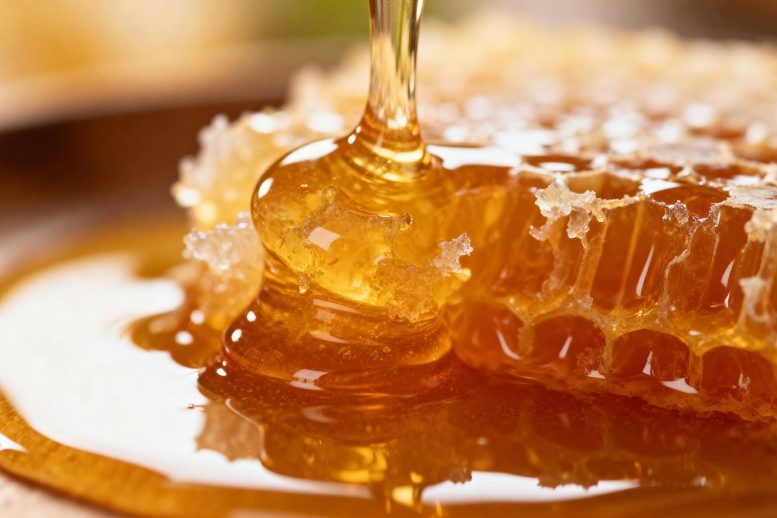
Researchers in Italy tested multifloral honey on human skin cells grown in a laboratory system designed to mimic skin.
The cells were treated with a 1% honey solution for 48 hours before exposure to ultraviolet radiation.
Compared with untreated cells, some honey-treated cells showed stronger defenses against UV-related stress, including greater antioxidant capacity.
The results also suggested changes linked to cell aging, protection and renewal.
UV radiation can stress skin cells and contribute to damage that may precede skin cancer, but the experiment did not test people.
Honey should not replace sunscreen, and the researchers say further laboratory, preclinical and clinical studies are needed before practical advice can be given.
The team is checking whether the cell changes also appear at the protein level and is evaluating a nanofiber system to deliver honey compounds.

A laboratory study suggests multifloral honey may help human skin cells respond to stress caused by ultraviolet radiation.
Researchers in Italy treated skin cells with honey before exposing them to UV radiation and observed changes linked to protective responses.
The study used a cell-based model, not human participants, and does not show that honey protects people from sun damage.
The researchers say more laboratory, preclinical and clinical studies are needed before practical recommendations can be made.
They caution that honey is not a substitute for sunscreen.
- Who
- Researchers at the University of Sassari in Italy, including Dr. Fikiye Fulya Kavak.
- What
- They studied whether multifloral honey could affect human skin cells’ responses to UV-induced stress.
- When
- The article was published on 2026-11-14; the experiment’s date is not stated.
- Where
- In a laboratory study in Italy using a bioreactor designed to simulate conditions in human skin.
- Why
- Researchers wanted to test whether multifloral honey could help skin cells withstand UV exposure.
This story does not have two clearly opposing sides.
Some cell cultures received a 1% multifloral honey treatment for 48 hours, while other cultures were untreated.
Researchers compared the cells’ responses to stress and measured the activity of selected genes.
SciTechDaily published an article describing the laboratory findings.
- Honey treatment
- 1% multifloral honey for 48 hours
- Study model
- Human skin stem cells, fibroblasts and keratinocytes grown together in a bioreactor
- Research institution
- University of Sassari, Italy
- Publication date
- 2026-11-14
- Next research steps
- Protein-level validation studies and biological evaluation of a nanofiber-based system
What people are saying
Our study was performed in cell-based experimental models, not in humans, so further laboratory, preclinical, and clinical studies are needed before any practical recommendation can be made
This led me to ask whether high-quality multifloral honey could also show measurable protective effects for human skin cells.