

Science & Tech · Space · 5 hrs ago
Hubble and Webb Observe the Cat’s Head Nebula
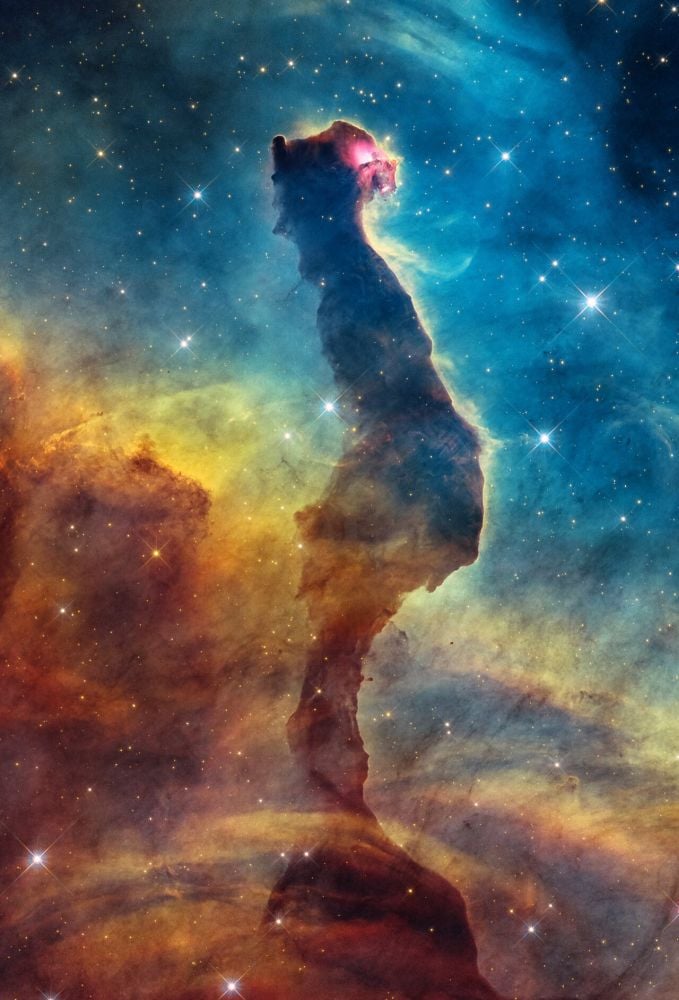
Hubble and the James Webb Space Telescope observed the Cat’s Head Nebula to help researchers study how stars form.
The nebula is part of the Carina Nebula, a star-forming region about 7,500 light-years away.
Its cat-like shape comes from gas and dust shaped by young stars’ radiation.
The region also contains massive stars, including Eta Carinae, whose powerful radiation and stellar winds affect the surrounding gas and dust.
Hubble captured visible light, while Webb used infrared, so the telescopes reveal different features: Webb shows more stars and background galaxies, while both images show how the massive stars shape the region.
The new images offer different views of the forces shaping star formation in the nebula.

Hubble and the James Webb Space Telescope recently observed the Cat’s Head Nebula to study star formation.
The nebula is a small part of the Carina Nebula, a star-forming region about 7,500 light-years away.
Hubble captured the object in visible light, while Webb observed it in near- and mid-infrared.
The images show how radiation and stellar winds from massive stars shape gas and dust in the region.
Webb’s infrared observations reveal stars and background galaxies differently from Hubble’s visible-light image.
- Who
- NASA’s Hubble Space Telescope and the James Webb Space Telescope observed the Cat’s Head Nebula.
- What
- They captured images to help researchers learn more about star formation.
- When
- Recently; the article was published on October 29, 2026.
- Where
- The Cat’s Head Nebula, in the Carina Nebula, about 7,500 light-years away.
- Why
- To learn more about star formation and how massive stars shape their surroundings.
This story does not have two clearly opposing sides.
This story does not have a timeline yet.
- Distance
- About 7,500 light-years
- Parent region
- Carina Nebula
- Hubble observations
- Visible light
- Webb observations
- Near- and mid-infrared
- Star-forming association
- Carina OB1