

Business · Companies · 48 mins ago
Lower Saxony premier criticizes Volkswagen over planned worker cuts
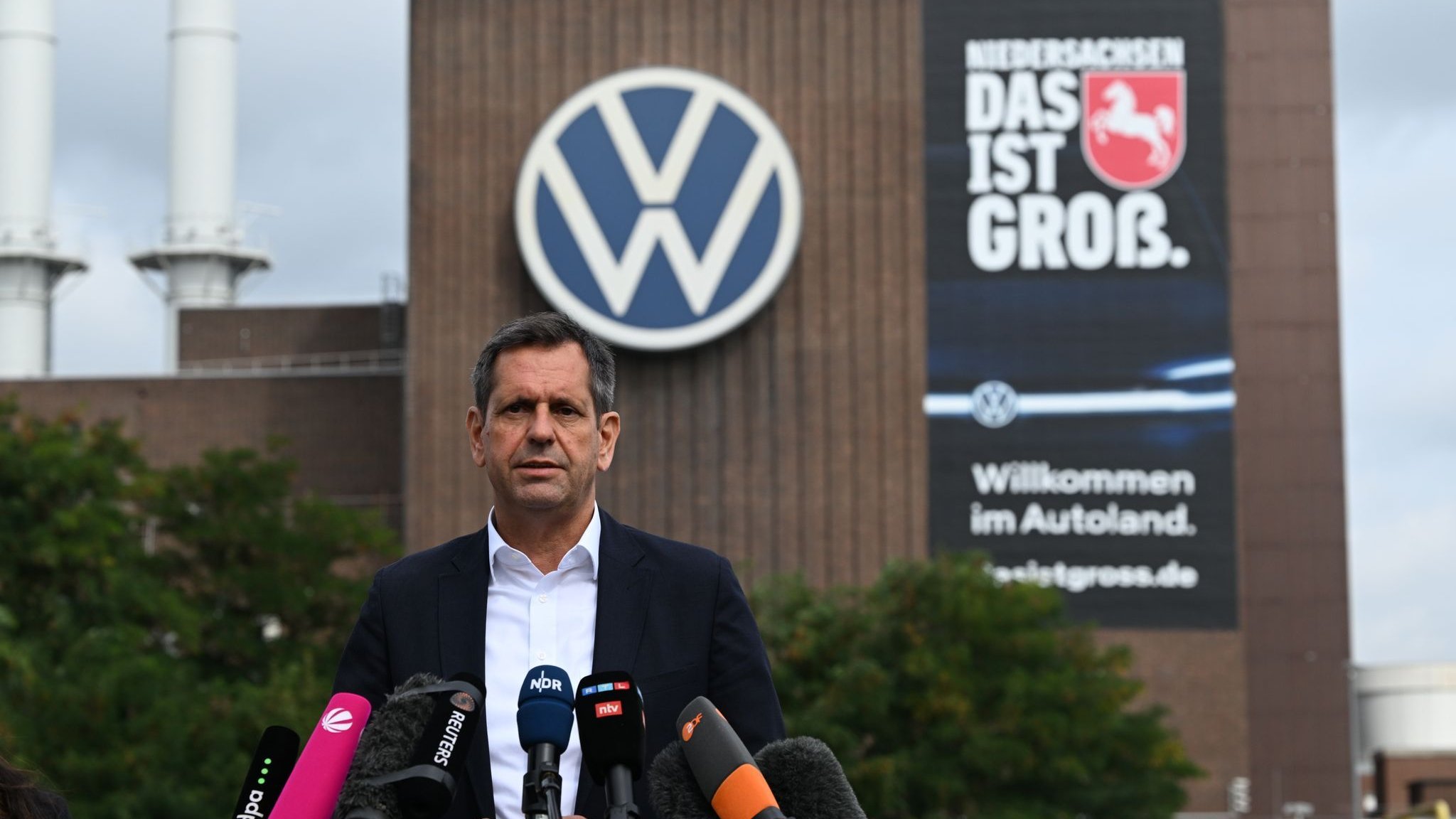
Lower Saxony premier Olaf Lies criticized Volkswagen’s approach in its pay talks with the IG Metall union.
Lies said the company should return to constructive cooperation and invest in production changes, rather than focus only on cuts to workers’ pay and benefits.
Volkswagen has cancelled ten collective agreements and is seeking wage freezes in 2027 and 2028, cuts to extra payments and more flexible working hours without extra pay.
The company also wants to cancel a 5.5% pay increase agreed in 2024 and due to take effect in 2031.
IG Metall says a tough conflict is likely, while Volkswagen says it wants a quick agreement.
The dispute follows a 2024 deal that included plans to cut 35,000 jobs in Germany by 2030.
The next negotiating round is planned for mid-December, and warning strikes may be possible after the no-strike period ends on 31 December.

Lower Saxony premier Olaf Lies criticized Volkswagen’s management over its demands in talks with the IG Metall union.
He said cancelling all collective agreements and presenting the move as a fait accompli was “no way to treat people.”
Volkswagen wants pay freezes, cuts to additional payments and more flexibility in working hours at its main brand.
Lies called for investment in production and urged the company to restart a stalled modernization project at its Wolfsburg plant.
The talks began in Emden, with another round planned for mid-December in Zwickau.
- Who
- Lower Saxony premier Olaf Lies criticized Volkswagen’s management during its negotiations with IG Metall.
- What
- Lies objected to Volkswagen’s demands for savings and called for investment in production.
- When
- The report was published on November 29, 2026; talks began on the Tuesday before publication.
- Where
- The dispute concerns Volkswagen’s negotiations in Germany. Talks began in Emden, and the next round is planned for Zwickau.
- Why
- Volkswagen is seeking extensive savings amid overcapacity and cost pressures; Lies said the company should pursue production solutions rather than demand cuts from employees.
Lower Saxony premier Olaf Lies and IG Metall
Volkswagen management
Approach to savings
Lower Saxony premier Olaf Lies and IG Metall
Lies called for investment in production and said the company should find solutions.
Volkswagen management
Management is seeking extensive cost-cutting measures at Volkswagen’s main brand.
Collective agreements
Lower Saxony premier Olaf Lies and IG Metall
Lies said cancelling all collective agreements and putting the move on the table was no way to treat people.
Volkswagen management
Volkswagen’s leadership cancelled ten collective agreements as part of its demands.
Employee terms
Lower Saxony premier Olaf Lies and IG Metall
IG Metall’s negotiator Thorsten Gröger called the demands disrespectful and said a hard fight seemed unavoidable.
Volkswagen management
Volkswagen wants pay freezes in 2027 and 2028, cuts to additional payments and more flexible working hours without pay compensation.
Volkswagen and the bargaining parties agreed on measures that included cutting 35,000 jobs in Germany by 2030.
Collective bargaining talks began in Emden amid protests against Volkswagen’s savings plans.
Handelsblatt published Lies’s criticism of Volkswagen’s management.
A second round of negotiations is planned in Zwickau.
The peace obligation is due to end, after which warning strikes are possible.
- State shareholding
- Lower Saxony holds 20% of the voting rights at Volkswagen.
- Contracts cancelled
- Volkswagen’s leadership cancelled 10 collective agreements.
- Proposed pay freezes
- No increases in 2027 and 2028.
- Current weekly hours
- 35 hours, which Volkswagen wants adjusted to operational demand without pay compensation.
- Prior job-cut agreement
- 35,000 jobs in Germany by 2030.
- Planned next talks
- Mid-December in Zwickau.
What people are saying
Cancelling all collective agreements and putting that on the table is no way to treat people.
We must invest in future-proof production models instead of demanding cuts from employees alone.
A hard fight seems unavoidable.
Anyone who writes papers like this wants conflict. We did not seek it. But we will fight it with full force.