

Science & Tech · Science & Environment · 2 hrs ago
New Theory Could Help Explain How Heavy Quarks Move Through Early-Universe Matter
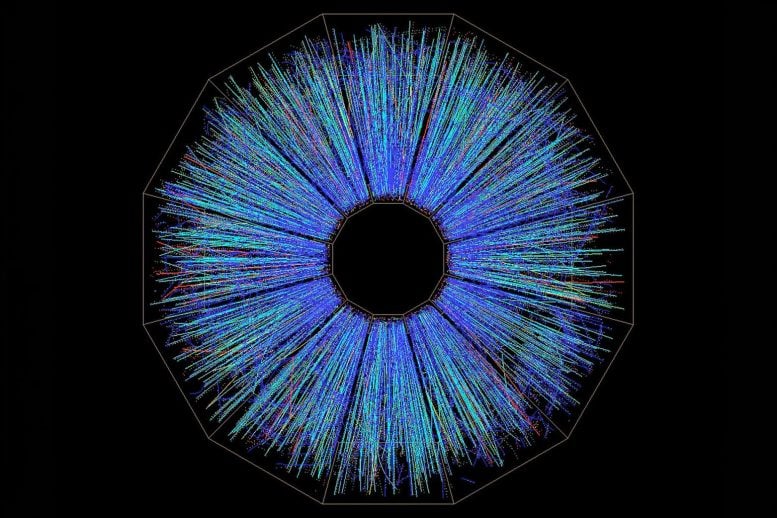
Researchers developed a theory of how fast-moving particles interact with fluids to help study quark-gluon plasma, the matter that filled the universe shortly after the Big Bang.
In particle accelerators, collisions of ions create tiny droplets of this plasma, which last for only a fraction of a second.
Scientists track heavy quarks moving through the droplets because their motion can carry clues about the plasma.
Einstein’s 1905 description of how particles move through fluids did not capture some interactions at speeds close to the speed of light.
The new calculation predicts how the plasma’s strong nuclear force changes a heavy quark’s momentum, including through rare, unusually large kicks.
Those rare kicks may reveal the plasma’s microscopic structure, helping scientists understand matter from the universe’s earliest moments.
The researchers reported their findings in Physical Review Letters; no further steps are specified.

Researchers developed a theory to describe how particles moving near the speed of light are pushed and pulled by a fluid.
The theory could help scientists interpret how heavy quarks move through quark-gluon plasma, a state of matter that existed shortly after the Big Bang.
It predicts how likely different changes in a heavy quark’s momentum are, including changes caused by unusually large kicks.
The researchers reported their findings in Physical Review Letters.
- Who
- Jean Du Plessis of MIT and Bruno Scheihing-Hitschfeld of the University of California at Santa Barbara developed the theory.
- What
- They developed a theory to predict how relativistic particles are pushed and pulled as they move through a fluid.
- When
- The article was published on November 15, 2026; the research date is not stated.
- Where
- The work concerns quark-gluon plasma created in particle accelerators; the research institutions are MIT and the University of California at Santa Barbara.
- Why
- The theory could help scientists learn about the plasma’s microscopic nature by studying heavy quarks’ changes in motion.
This story does not have two clearly opposing sides.
Botanist Robert Brown observed grains of pollen moving erratically in still water.
Albert Einstein explained how random forces from atoms and molecules make larger particles move through a fluid.
Matter existed as a trillion-degree mixture of quarks and gluons for a few microseconds before forming more stable protons and neutrons.
Jean Du Plessis and Bruno Scheihing-Hitschfeld developed a theory of relativistic particles moving through a fluid and reported it in Physical Review Letters.
- Researchers
- Jean Du Plessis and Bruno Scheihing-Hitschfeld
- Institutions
- MIT and the University of California at Santa Barbara
- Publication
- Physical Review Letters
- Early-universe plasma
- A trillion-degree mixture of quarks and gluons
- Plasma lifetime
- A few microseconds after the Big Bang
1 source
What people are saying
Our result reveals a new source of information carried by heavy quarks in rare, unusually large changes in their motion