

Science & Tech · Space · 8 hrs ago
Lumina simulation models the universe’s first two billion years
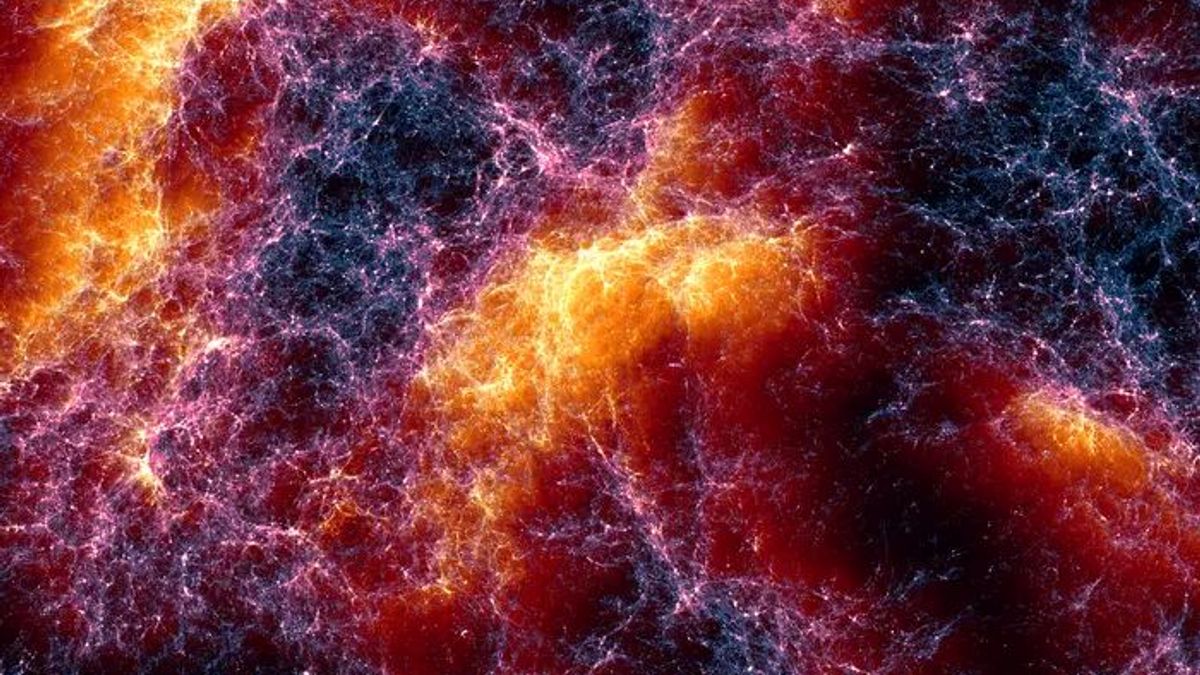
About 380,000 years after the Big Bang, the universe entered a dark age because stars and galaxies had not yet formed.
Neutral hydrogen let light from the cosmic microwave background travel freely, but the lack of luminous objects meant astronomers could not directly observe what came next.
A new computer model called Lumina simulates two billion years of cosmic evolution across a region 1.6 billion light-years wide.
It tracks how hydrogen and helium became re-ionized, a change needed to end the dark age.
The simulation also resolves galaxies and other bright objects that may have driven that change.
Astronomers will compare its predictions with observations, including those from the James Webb Space Telescope, to test whether the model explains what happened.
Lumina aims to help explain how the early universe evolved, beyond what telescopes can directly show.

The Lumina computer simulation models two billion years of cosmic evolution after the universe’s early dark ages.
It covers a region of space 1.6 billion light-years wide.
The project aims to show how hydrogen and helium became re-ionized and how galaxies and other luminous objects drove that change.
Researchers say the simulation can help turn theories about the early universe into detailed predictions for comparison with observations.
- Who
- Researchers behind the Lumina project, including Aaron Smith of the University of Texas at Dallas and lead investigator Oliver Zier.
- What
- A computer simulation models two billion years of cosmic evolution across a vast region of space.
- When
- Not stated
- Where
- A simulated patch of space 1.6 billion light-years wide; the project involves researchers at the University of Texas at Dallas and the Harvard & Smithsonian Center for Astrophysics.
- Why
- To model how hydrogen and helium changed into their modern forms and to help interpret observations of the early universe.
This story does not have two clearly opposing sides.
This story does not have a timeline yet.
- Simulation period
- 2 billion years of cosmic evolution
- Simulated region
- 1.6 billion light-years wide
- Key elements
- Hydrogen and helium
- Lead investigator
- Oliver Zier
- Project author
- Aaron Smith, University of Texas at Dallas
What people are saying
For the first time, we can follow along as both hydrogen and helium changed into their modern form across such an enormous volume of the universe, while still resolving the galaxies and other luminous objects driving that transformation.
To understand what we are seeing with this telescope, we need to translate our theories into detailed predictions.