

Science & Tech · Science & Environment · 3 hrs ago
Arctic Winter Sea Ice Could Decline More Than Previous Estimates Suggested
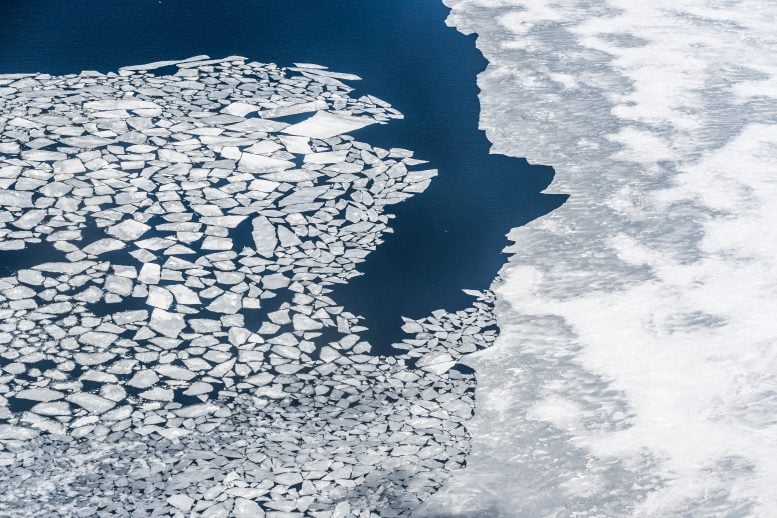
Researchers revised forecasts for Arctic winter sea ice using evidence from a warmer period about 6,000 years ago.
The study team compared traces left by sea-ice and open-water algae in ocean sediments with simulations from 27 climate models.
The revised projections show about one million square kilometers less ice than earlier estimates.
The method also narrowed the range of uncertainty in the projections by as much as 85%.
Less Arctic ice could affect weather far from the region, because sea ice influences how much heat and moisture the ocean releases into the air.
The analysis also suggests snowfall over southeast Greenland and rain in the Mediterranean may be underestimated, with possible implications for Greenland’s ice sheet and flood risk in southern Europe.
Researchers say the results offer clearer maps of where winter ice may disappear in the coming decades.

Researchers estimate that Arctic winter sea ice could be about one million square kilometers lower than previous projections suggested.
The study used ancient evidence from a warmer Arctic and climate-model simulations to revise the estimates.
The researchers examined algae-produced biomarkers in ocean sediment cores dating to about 6,000 years ago.
They compared their reconstruction with simulations from 27 climate models and gave more weight to models that better matched the evidence.
The study also suggested that snowfall over southeast Greenland and rainfall in the Mediterranean may be underestimated.
- Who
- Researchers from the University of Cambridge and Mexico’s Centro de Investigación en Matemáticas.
- What
- The researchers revised projections of Arctic winter sea ice downward by about one million square kilometers.
- When
- The findings were published on October 22, 2026.
- Where
- The Arctic; the researchers used ocean sediment cores and climate-model simulations.
- Why
- Ancient sea-ice evidence helped identify models that better reproduced past conditions, improving the projections.
This story does not have two clearly opposing sides.
Warmer Arctic conditions during the mid-Holocene contributed to reduced sea-ice cover.
The Arctic recorded its lowest maximum sea-ice extent since modern measurements began.
The study’s findings were published in Nature Geoscience.
- Projected reduction
- About 1 million square kilometers
- Model comparison
- 27 climate models
- Ancient evidence
- Ocean sediment cores dating to about 6,000 years ago
- Uncertainty reduction
- Up to 85%
- Publication date
- October 22, 2026
What people are saying
It doesn’t matter if the warming is natural variation or caused by human activity: if it warms, sea ice is going to melt.
The future projections similarly end up being lower than previous estimates, by about a million square kilometers.
By using evidence from the past, we can now produce more reliable maps of where Arctic winter sea ice is likely to disappear.