

Science & Tech · Science & Environment · 2 hrs ago
Ceres may have more surface salt than Dawn data suggested
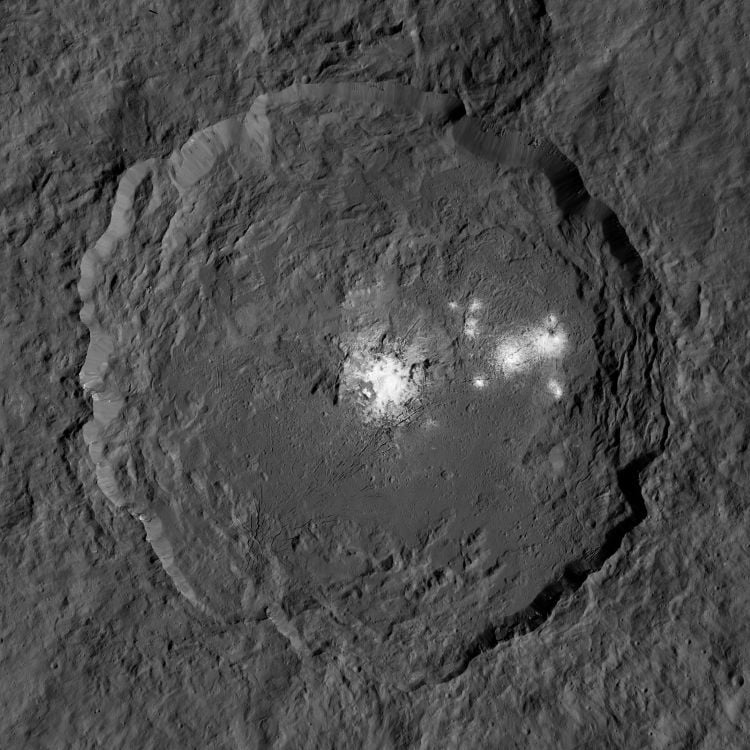
Researchers from the California Institute of Technology used NASA’s Dawn data and computer models to study water ice and salt on Ceres, the largest object in the asteroid belt.
Dawn explored the dwarf planet from 2015 to 2018 and recorded bright surface spots thought to be salt deposits.
The study suggests ice may hide salt deposits that are mixed with it, so earlier observations could have underestimated how much salt is present.
The deposits may be 30 to 50 percent more abundant than previously estimated.
The researchers say the salty ice loses water through sublimation, leaving salt behind, while landslides can expose fresh ice at the surface.
This helps explain how salt-rich bright spots form over time rather than starting out with large amounts of salt.
The findings offer a new way to understand Ceres’ surface and its history of water ice activity.

A study suggests Ceres may have 30 to 50 percent more surface salt than earlier estimates based on NASA’s Dawn spacecraft data.
Researchers say water ice mixed with salt may have concealed some deposits from observation.
The study proposes that sublimation enriches salt at the surface as water ice evaporates.
Landslides may expose more ice, which then evaporates and leaves bright salt deposits.
The findings are based on Dawn data and computer models.
- Who
- Two researchers from the California Institute of Technology conducted the study.
- What
- They found that Ceres’ surface salt deposits may be 30 to 50 percent greater than previously hypothesized.
- When
- The study was published on October 31, 2026.
- Where
- Ceres, the largest object in the main asteroid belt.
- Why
- The researchers aimed to address a gap between observations of surface water ice and salt deposits and what is happening on Ceres.
This story does not have two clearly opposing sides.
NASA’s Dawn spacecraft explored Ceres.
Universe Today reported on the study’s findings about Ceres’ salt deposits.
- Estimated increase
- 30 to 50 percent more salt than previously hypothesized
- Spacecraft
- NASA’s Dawn
- Dawn exploration
- 2015 to 2018
- Research institution
- California Institute of Technology (Caltech)
What people are saying
Ice in deposits with salts sublimates more readily and may move to colder areas