

Business · Economy · 4 hrs ago
Economist Says Fed Chair Warsh Is Focused on Managing Long-Term Borrowing Costs
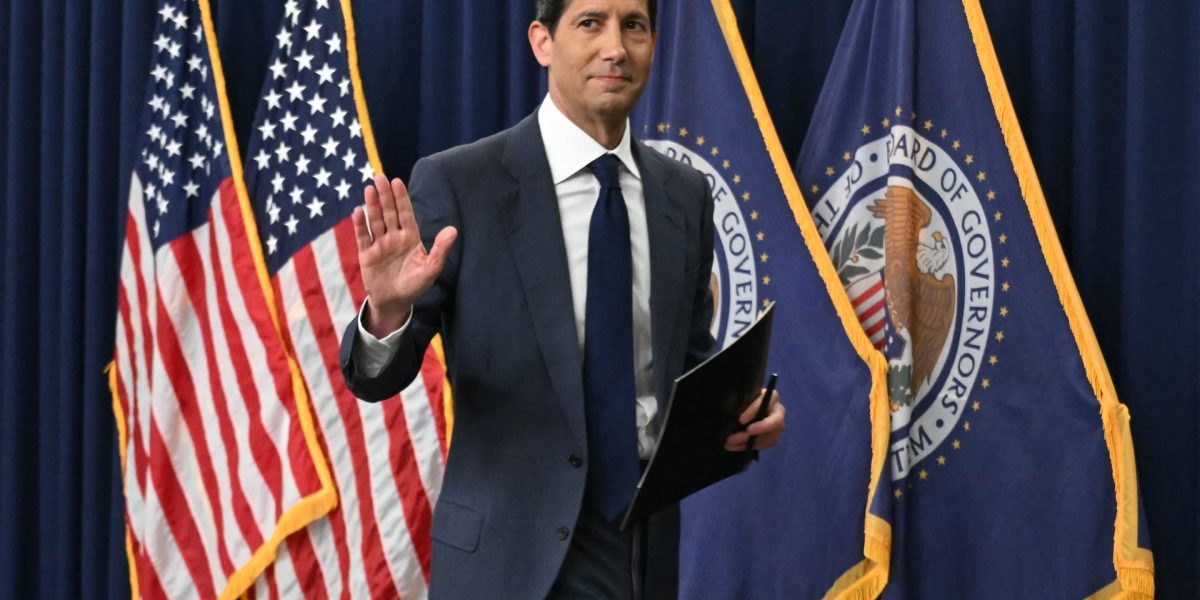
Brookings economist Robin Brooks says Fed Chair Kevin Warsh is focused on keeping long-term borrowing costs manageable, rather than fitting neatly into the usual “hawk” or “dove” categories.
Warsh’s comments and decisions have sent mixed signals about whether he wants tighter or looser monetary policy.
Brooks argues that the pressure comes from rising U.S. debt and Treasury yields, which could make government borrowing more expensive.
U.S. gross debt is above $40 trillion, and interest costs exceeded $1 trillion in the 2026 fiscal year.
Treasury Secretary Scott Bessent has also taken steps that Brooks sees as efforts to limit borrowing costs, including announcing more long-term bond buybacks.
Keeping yields under control could constrain the Fed’s ability to fight inflation independently, a risk known as fiscal dominance.
Yields have recently fallen below 5% for 10-year Treasury bonds, but the story gives no specific next step from Warsh or the Fed.

Economist Robin Brooks says Federal Reserve Chair Kevin Warsh is focused on managing long-term borrowing costs rather than choosing between hawkish and dovish policy.
Brooks links the approach to the precarious U.S. debt picture and rising Treasury yields.
U.S. gross debt is above $40 trillion, and debt-interest costs exceeded $1 trillion in fiscal year 2026.
Brooks suspects the Federal Reserve and Treasury Department are acting in a de facto accord to keep borrowing costs stable.
He warns that yield management could contribute to fiscal dominance, in which debt and deficits constrain the Fed’s ability to manage monetary policy.
- Who
- Robin Brooks, a senior fellow at the Brookings Institution, made the assessment about Federal Reserve Chair Kevin Warsh.
- What
- Brooks says Warsh is focused on managing long-term yields and borrowing costs, rather than being simply hawkish or dovish.
- When
- The article was published on November 1, 2026. Brooks made the comments in a Substack post on Thursday.
- Where
- The United States.
- Why
- Brooks says the U.S. debt picture is precarious and rising Treasury yields threaten to worsen borrowing costs.
This story does not have two clearly opposing sides.
Warsh suggested considering alternative inflation gauges and said the bond market would do some of the Fed’s tightening work.
Warsh delivered a hawkish speech at the Jackson Hole conference.
Warsh led the Fed to a unanimous rate hike.
Warsh held off on backing another rate hike despite inflation heating up again.
Brooks wrote in a Substack post that Fed policy was focused on yield curve management.
- U.S. gross debt
- Above $40 trillion
- Publicly held debt
- 100% of GDP
- Debt-interest costs
- More than $1 trillion in fiscal year 2026
- 10-year Treasury yield
- Dipped back below 5%
- Brooks’s institution
- Brookings Institution
What people are saying
We’re not in hawkish or dovish land. What’s happening is yield curve management, which itself is a function of how precarious the U.S. debt picture is,
The bottom line is that inflation and other macro data are secondary,
The twists and turns in Fed policy are about what’s going on with long-term yields.
Warsh is neither hawk nor dove,