

Archive · 27 Dec 2025
James Webb Telescope Captures Ancient Supernova
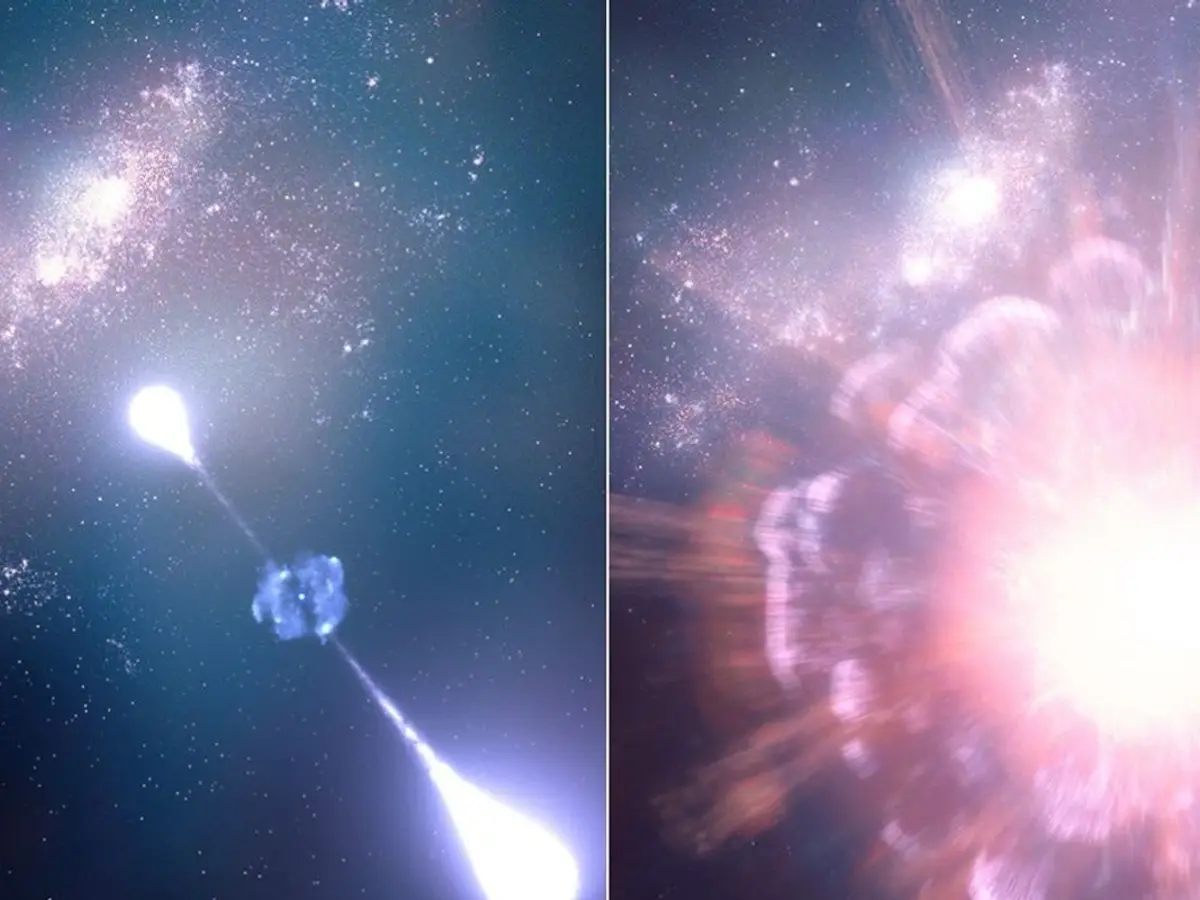
Scientists using the James Webb Space Telescope found a supernova that exploded a very long time ago, when the universe was just 730 million years old.
This supernova was linked to a bright burst of gamma rays called GRB 250314A.
The telescope's special camera, called NIRCam, helped scientists see the fading light of the explosion and study it even though it was very far away.
This discovery is important because it shows that supernovae from the early universe are similar to those we see today.
Scientists plan to study the supernova more in the next few years to learn about the galaxy where it happened.

NASA’s James Webb Space Telescope detected a supernova from 730 million years after the Big Bang.
The supernova was associated with a gamma-ray burst labelled GRB 250314A.
The discovery was confirmed by follow-up observations with the European Southern Observatory's Very Large Telescope.
The supernova's properties are similar to those of nearby, well-studied supernovae.
Scientists plan to observe the supernova again in the next one to two years to study its host galaxy.
- Who
- International team of astronomers using NASA’s James Webb Space Telescope (JWST)
- What
- Detected a supernova from the early universe
- When
- Supernova exploded 730 million years after the Big Bang, detected in March 2025
- Where
- In the early universe during the era of reionization
- Why
- To study the properties of early universe supernovae and their host galaxies
- Telescope
- James Webb Space Telescope (JWST)
- Supernova Age
- 730 million years old
- Gamma-Ray Burst
- GRB 250314A
- Detection Date
- March 2025
- Journal
- Astronomy & Astrophysics
- Instrument
- NIRCam
- Observation Period
- 110 days after initial burst
