Archive · 24 Sep 2025
Scientists Discover Human Body Emits Light That Diminishes at Death
Imagine your body glows, but you can't see it!
Scientists found that humans, like other living things, emit a very faint light, called biophotons.
This light comes from processes in our cells and is too weak to see without special tools.
The light fades when something dies.
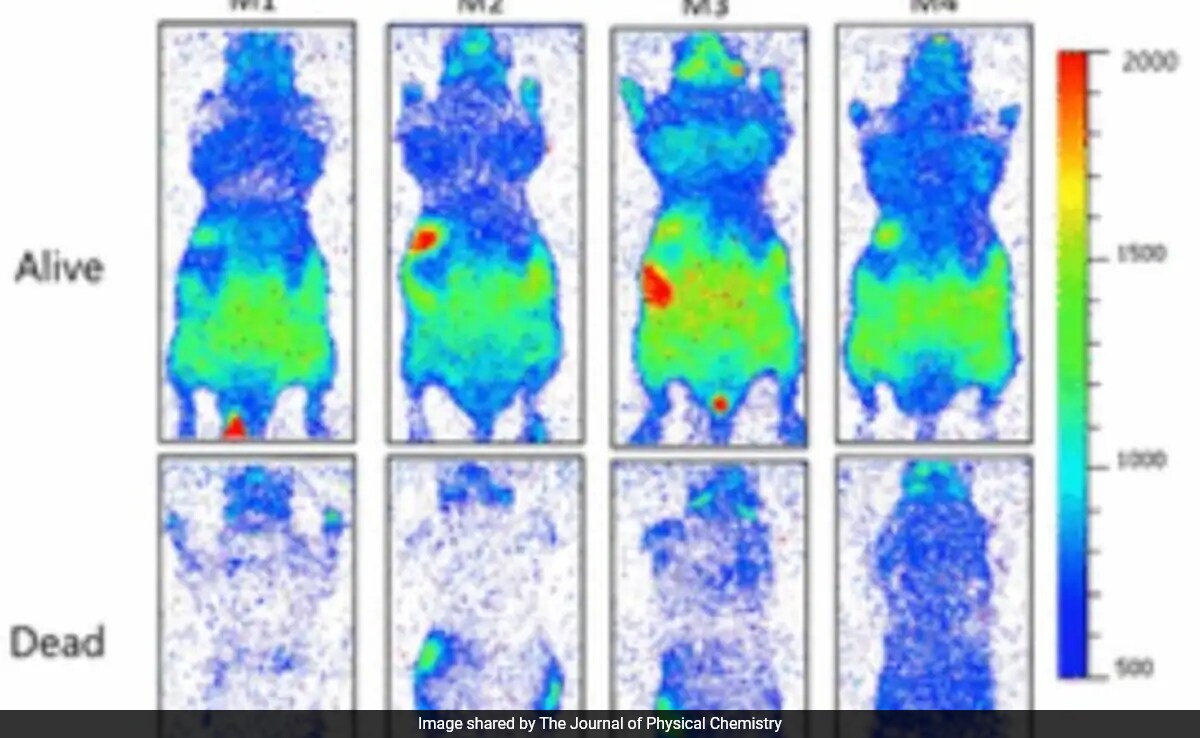
Scientists studied this using mice and plants.
It could potentially help find health problems in the future!

The human body emits faint visible light that fades at death.
This phenomenon is called ultraweak photon emission or biophoton emission.
Biophotons are emitted by living cells as a byproduct of metabolic processes.
Experiments used mice and plant leaves to study this effect.
Monitoring biophoton emissions could help identify tissue stress and detect diseases.
- Who
- Researchers from the University of Calgary and the National Research Council of Canada
- What
- Discovered that the human body emits faint visible light that diminishes at death
- When
- The study was published in The Journal of Physical Chemistry Letters.
- Where
- The experiment was conducted at the University of Calgary and National Research Council of Canada.
- Why
- To understand the biological processes that cause ultraweak light emission and its potential uses.
Research Findings
Potential Applications
Light Emission Observation
Research Findings
All living organisms on Earth subtly glow during their lifespan before their glow fades as they die.
Potential Applications
Monitoring biophoton emissions may become a non-invasive way to identify tissue stress in humans, animals, and crops to help with the detection of future diseases and environmental threats.
- Phenomenon Name
- Ultraweak photon emission (UPE) or biophoton emission
- Light Source
- Reactive oxygen species (ROS)
- Wavelength
- 200 to 1,000 nanometers
- Experiment Subjects
- Mice, Thale cress, Dwarf umbrella tree
- Research Institutions
- University of Calgary, National Research Council of Canada