

Archive · 6 Sep 2026
UN Assembly Declares November 27 Day Against Child Marriage
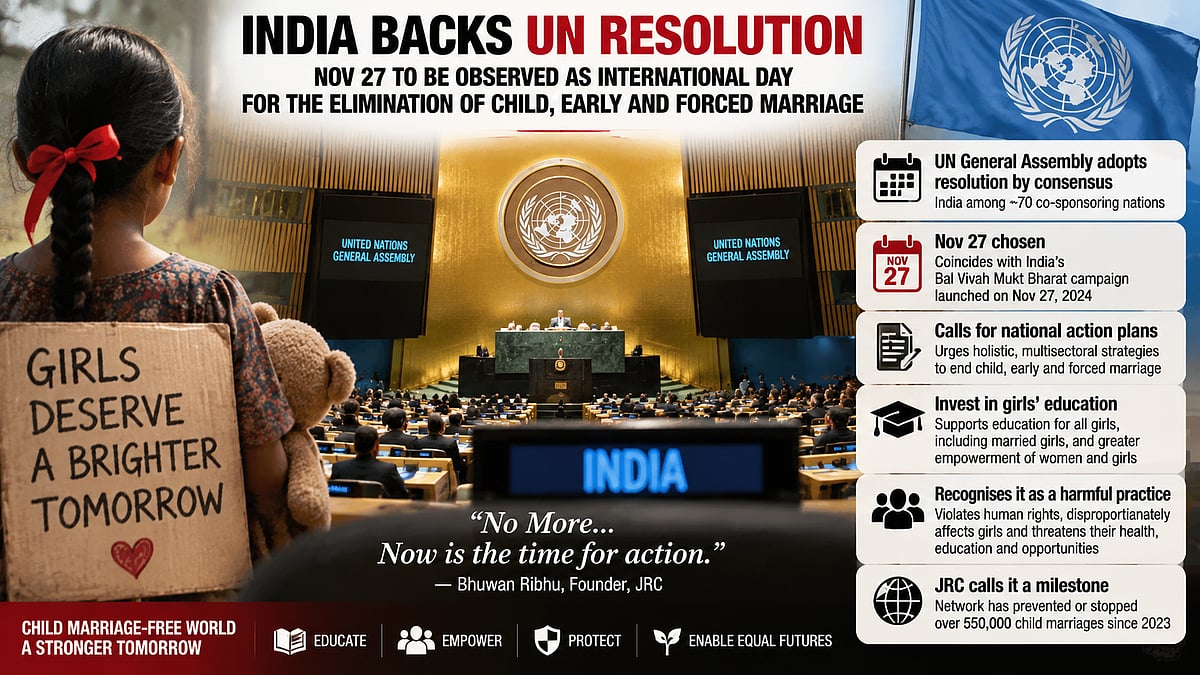
The United Nations chose November 27 as a special day to help end child, early, and forced marriage.
The General Assembly approved the resolution by consensus.
Sierra Leone led the proposal, and India was one of the countries supporting it.
About 66 to 70 countries backed the initiative.
The resolution asks countries and organizations to teach people about the harms of child marriage.
It also encourages strong national plans, laws, education, and support for girls.
Married girls and young women should be helped to continue or return to school.
Supporters say child marriage can harm girls’ education, health, safety, and future opportunities.
They also say that a special day is only a starting point and that governments must take sustained action.

The 193-member UN General Assembly adopted by consensus a Sierra Leone-led resolution designating November 27 as the International Day for the Elimination of Child, Early and Forced Marriage.
India and approximately 66 to 70 other countries co-sponsored or backed the resolution.
The resolution calls for awareness campaigns, advocacy, education, and holistic, multisectoral national strategies to end child marriage.
It urges investment in girls’ education, including programs helping married girls and young women continue or return to school, and promotes the empowerment of women and girls.
November 27 coincides with India’s Bal Vivah Mukt Bharat campaign, launched in 2024, which aims to reduce child marriage by 10% by 2026 and end it nationally by 2030.
- Who
- The 193-member United Nations General Assembly, led by Sierra Leone and supported by India and dozens of other countries, adopted the resolution.
- What
- It designated November 27 each year as the International Day for the Elimination of Child, Early and Forced Marriage.
- When
- The resolution was adopted on Friday; the international day will be observed annually on November 27.
- Where
- The decision was made in the United Nations General Assembly; November 27 is also the date of India’s Bal Vivah Mukt Bharat campaign.
- Why
- The resolution seeks to build awareness and encourage laws, national action plans, education, and coordinated efforts to eliminate child, early, and forced marriage.
Symbolic Recognition and Global Awareness
Concrete Action and Accountability
What the designation can achieve
Symbolic Recognition and Global Awareness
Supporters say an annual international day creates global attention, reinforces the rights and dignity of girls, and encourages governments, communities, schools, faith leaders, and civil society to act together.
Concrete Action and Accountability
Advocates also caution that the designation alone cannot end child marriage; they call for comprehensive laws, funded national action plans, accountable institutions, enforcement, and sustained political will.
How to describe child marriage
Symbolic Recognition and Global Awareness
The UN resolution describes child, early, and forced marriage as a harmful practice that violates or impairs human rights and harms education, health, safety, and economic opportunities.
Concrete Action and Accountability
Just Rights for Children goes further, describing child marriage as a crime and a form of child sexual abuse, emphasizing the need for stronger legal and institutional responses.
- International day
- November 27 each year
- Resolution lead
- Sierra Leone
- International support
- India and approximately 66 to 70 other countries supported the resolution
- Recommended measures
- Awareness campaigns, advocacy, education, and holistic multisectoral national strategies
- India campaign
- Bal Vivah Mukt Bharat, also known as Child Marriage Free India, launched on November 27, 2024
- India campaign goals
- Reduce child marriage prevalence by 10% by 2026 and make India child marriage-free by 2030
- Reported network achievement
- Just Rights for Children says it has prevented or stopped more than 550,000 child marriages since 2023
