

Archive · 8 Nov 2025
New Space Technologies Aim for Fuel-Less Interstellar Travel
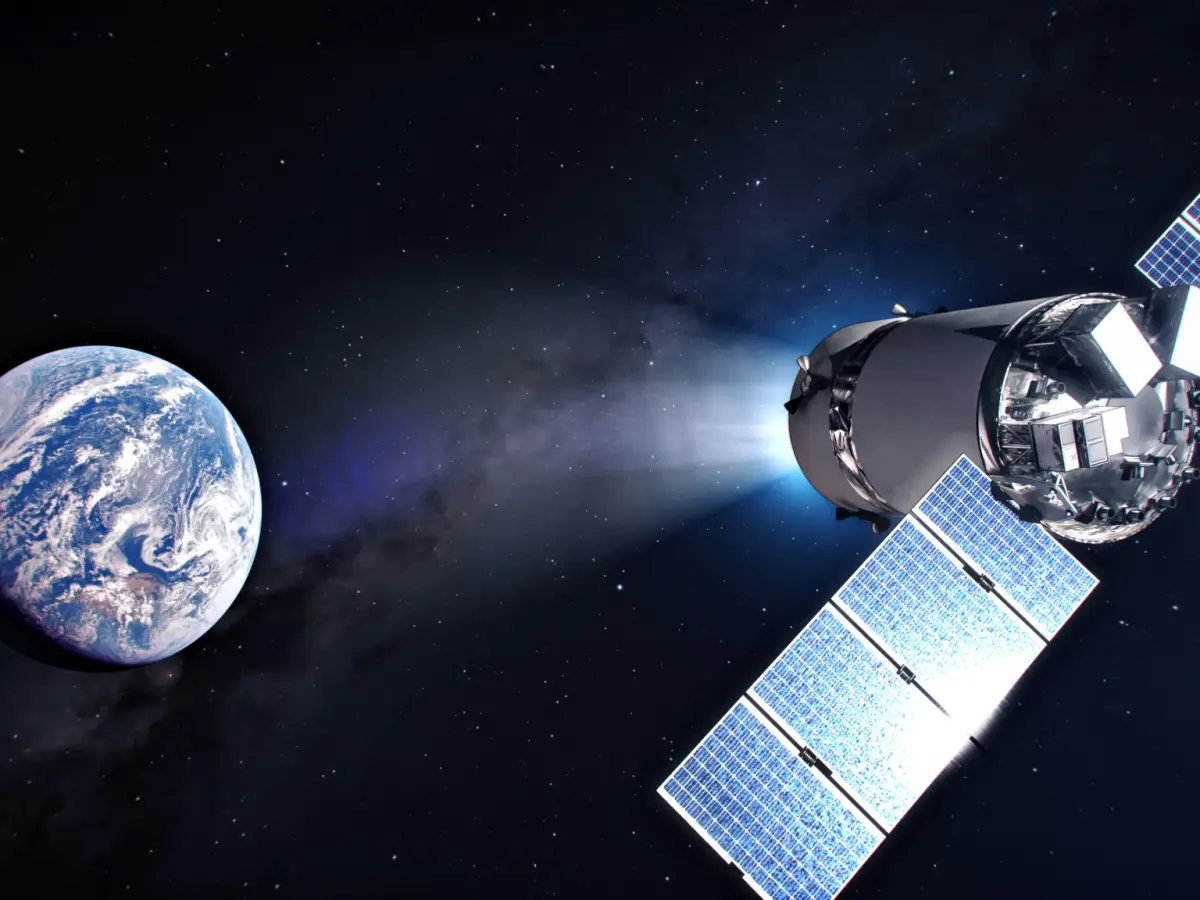
Imagine trying to push a toy boat across a bathtub.
Usually, you need to keep pushing it yourself, which is like a rocket needing fuel.
But what if you could use something already there to push it?
Some new ideas in space travel are like that!
One way is like using a big kite in space – the Sun's light gently pushes it along, like wind on a sail.
This is called a solar sail.
Another trick is like when you swing around a pole and use the spin to go faster – spacecraft can fly close to planets and use their 'spin' to get a boost, called a gravity assist.
There are also ideas to use the Sun's 'wind' of tiny particles, either with big magnetic fields or charged wires, to push spaceships.
These ways don't need to carry heavy fuel, which could let us travel much farther and faster, maybe even to other stars!

New research explores 'propellantless' propulsion systems for space travel, aiming to eliminate the need for fuel.
Solar sails use the pressure of sunlight to propel spacecraft, with Japan's IKAROS mission demonstrating the technology.
Gravity assists, a proven method, utilize a planet's orbital momentum to accelerate spacecraft without fuel.
Emerging concepts like magnetic and electric sails harness the solar wind for continuous thrust.
While promising, these technologies face significant engineering challenges related to scale, materials, and power.
- Who
- Space exploration researchers and engineers
- What
- Exploring and developing fuel-less propulsion systems for spacecraft, including solar sails, gravity assists, and magnetic/electric sails.
- When
- Ongoing research with historical demonstrations (e.g., 2010).
- Where
- Earth-based research and applied in space missions.
- Why
- To overcome the fundamental limitation of fuel weight in space travel, enabling potentially faster and further exploration, including interstellar travel.
Advantages
Challenges
Propulsion Method
Advantages
Solar sails harness sunlight pressure for continuous acceleration. Gravity assists use planetary momentum for speed boosts. Magnetic and electric sails utilize the solar wind for thrust.
Challenges
Solar sails' effectiveness decreases with distance from the Sun. Gravity assists depend on rare planetary alignments and are hard to adjust. Magnetic and electric sails require enormous, complex infrastructure and power.
Technological Maturity
Advantages
Gravity assists are the oldest and most proven. Solar sails have been successfully demonstrated (e.g., Japan's IKAROS mission).
Challenges
Magnetic and electric sails are newer concepts with enormous technological hurdles.
Mission Scope
Advantages
These technologies enable extended missions and potentially interstellar travel without the weight of fuel.
Challenges
Engineering challenges like constructing vast sails, maintaining cryogenic temperatures, and managing power-intensive tethers remain significant.
- Propellantless Propulsion Concepts
- Solar Sails, Gravity Assists, Magnetic Sails, Electric Sails
- Solar Sail Principle
- Uses photon pressure from sunlight to push spacecraft.
- Gravity Assist Principle
- Steals orbital momentum from planets to gain speed.
- Solar Wind Sail Principle
- Harnesses charged particles in the solar wind for thrust.
- Demonstrated Technology
- Solar sails (Japan's IKAROS mission), Gravity Assists (NASA's Voyager probes)