

Archive · 27 May 2025
Astronomers Observe Rare Galactic 'Cosmic Joust' 11 Billion Light-Years Away
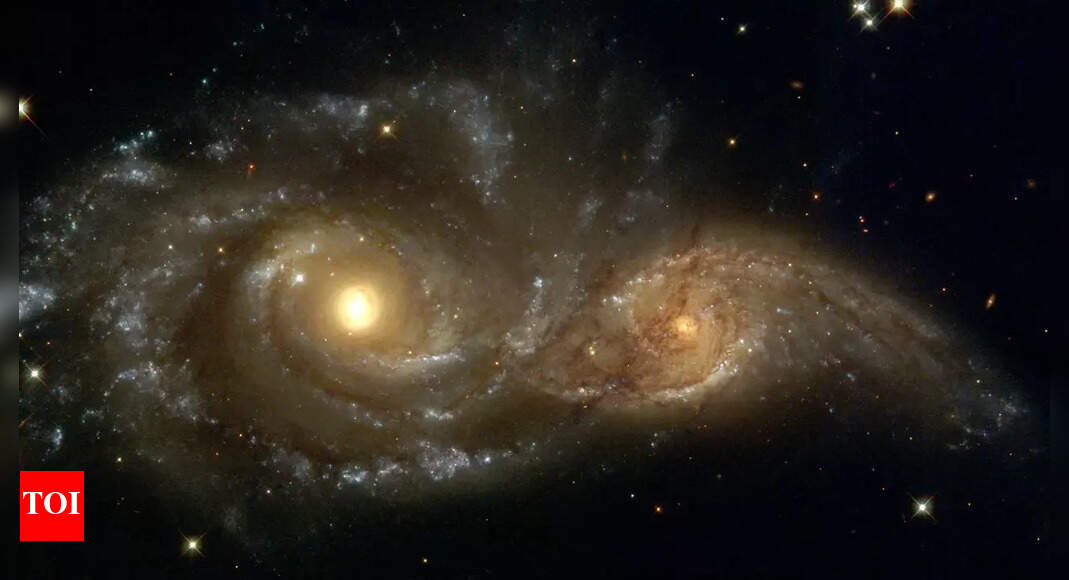
Imagine two galaxies, like giant cities, crashing into each other in space, 11 billion years ago!
One galaxy has a powerful center that shoots out strong energy, like a super-bright flashlight.
This energy is so strong that it pushes away the stuff needed to make new stars in the other galaxy.
It's like the first galaxy is stopping the other from having any more babies (stars).
Scientists watched this 'cosmic joust' using big telescopes, learning how galaxies grow and change over billions of years.
The event is rare because the light from one galaxy is so bright, it usually hides the other one.

Astronomers observed a rare interaction between two galaxies, 11 billion light-years from Earth.
The galaxies are colliding at a speed of over 1.8 million kilometers per hour.
One galaxy's quasar emits intense radiation, hindering star formation in its neighbor.
The radiation is a thousand times stronger than that of the Milky Way's core.
Scientists are witnessing how a quasar's radiation impacts star-forming gas in another galaxy.
- Who
- Astronomers using powerful telescopes observed the event.
- What
- A 'cosmic joust' between two galaxies, involving the emission of intense radiation from one, hindering star formation in the other.
- When
- Observed over a period of nearly four years.
- Where
- Approximately 11 billion light-years from Earth.
- Why
- To understand galaxy formation, star birth, and the forces shaping the distant universe.
- Distance from Earth
- 11 billion light-years
- Galactic Interaction Speed
- 1.8 million kilometers per hour
- Observation Period
- Four years
- Source of Intense Radiation
- Quasar
- Reference for Radiation Strength Comparison
- Milky Way