

Archive · 30 Sep 2025
Study Shows Earth's Influence Causes Moon's Rust
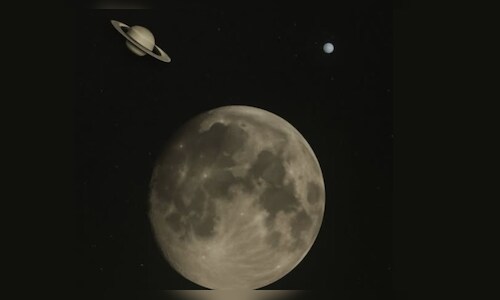
Imagine the Moon getting a little bit rusty!
Scientists have found rust (a type of iron oxide called hematite) on the Moon, especially near its poles.
This rust is formed because of oxygen from Earth traveling through space and landing on the Moon.
This happens when the Moon goes through Earth's magnetic tail, which is like an invisible shield.
During this time, oxygen particles from Earth's atmosphere reach the Moon and react with iron in the Moon's rocks, causing them to rust.
Scientists learned about this by doing experiments to recreate the conditions on the moon.
It helps scientists learn how Earth and the Moon are connected and how they affect each other.

Scientists discovered hematite (rust) on the Moon's surface.
The rust is primarily found near the Moon's poles.
The rust is formed because of oxygen from Earth.
Earth's atmospheric particles travel to the Moon during certain periods.
The discovery helps understand the interaction between Earth and the Moon.
- Who
- Scientists and researchers
- What
- Discovered rust (hematite) on the Moon
- When
- The discovery was recently announced. Data from India's Chandrayaan-1 mission led to an initial discovery in 2020.
- Where
- The Moon's surface, especially near the poles
- Why
- To understand the interaction between the Earth and the Moon and the processes of lunar geological changes.
- Discovery
- Hematite (rust) found on the Moon's surface
- Location
- Moon's surface, especially near poles
- Cause
- Oxygen from Earth reacting with iron on the Moon
- Process
- Earth's atmospheric particles (Earth wind) travel to the Moon
- Observation Period
- Lunar cycle: ~5 days per month
- Previous Discovery
- Hematite detected in 2020 by Chandrayaan-1