1 year ago
Gravitational Wave Anniversary: Testing Einstein & Hawking
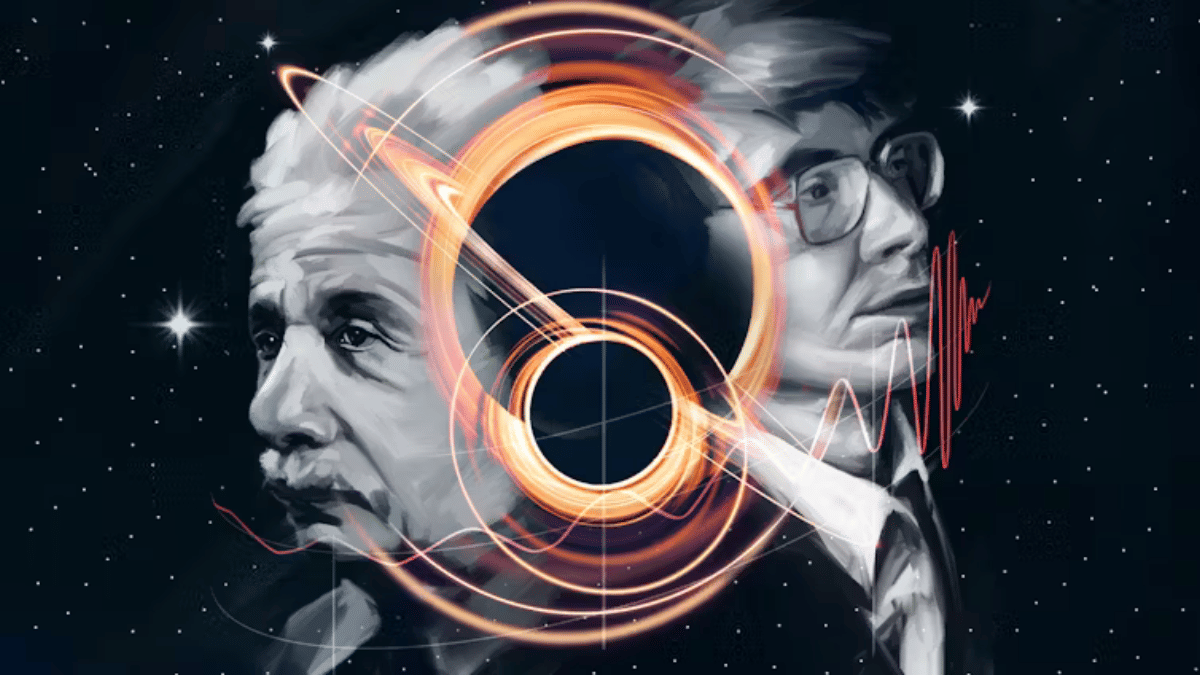
Imagine space as a giant sheet.
Massive objects like black holes cause ripples in this sheet, called gravitational waves.
Scientists detected these ripples for the first time ten years ago, proving Einstein's theory correct.
Now, they've used these ripples to test a theory by Stephen Hawking about black holes.
Hawking said black holes can't shrink, and the new data confirms he was right.
By studying how black holes collide, scientists can learn more about these mysterious objects and the universe.

Scientists celebrate 10 years since the first detection of gravitational waves.
The initial discovery confirmed Einstein's theory of general relativity.
New findings confirm Hawking's theory that black holes cannot shrink.
The new signal, GW250114, is almost a carbon copy of the first detected gravitational wave.
These findings advance our understanding of black holes and the universe.
- Who
- Scientists, LIGO/Virgo/KAGRA collaboration
- What
- Confirmed Hawking's black hole theory using gravitational waves
- Where
- United States (LIGO), Italy (Virgo), Japan (KAGRA) and other global collaborations
- When
- Ten years after first gravitational wave detection (2015)
- Why
- To test Stephen Hawking's theory about black holes using data from colliding black holes.
Key facts
- Discovery Date
- September 14, 2015 (first detection)
- Gravitational Waves
- Ripples in space-time caused by massive objects
- First Signal
- GW150914 (collision of two black holes)
- Detectors
- LIGO, Virgo, KAGRA
- Hawking's Law
- Area of a black hole's event horizon must increase