

Archive · 2 Oct 2026
Sergeant Stubby: Stray Dog Who Became World War I Hero
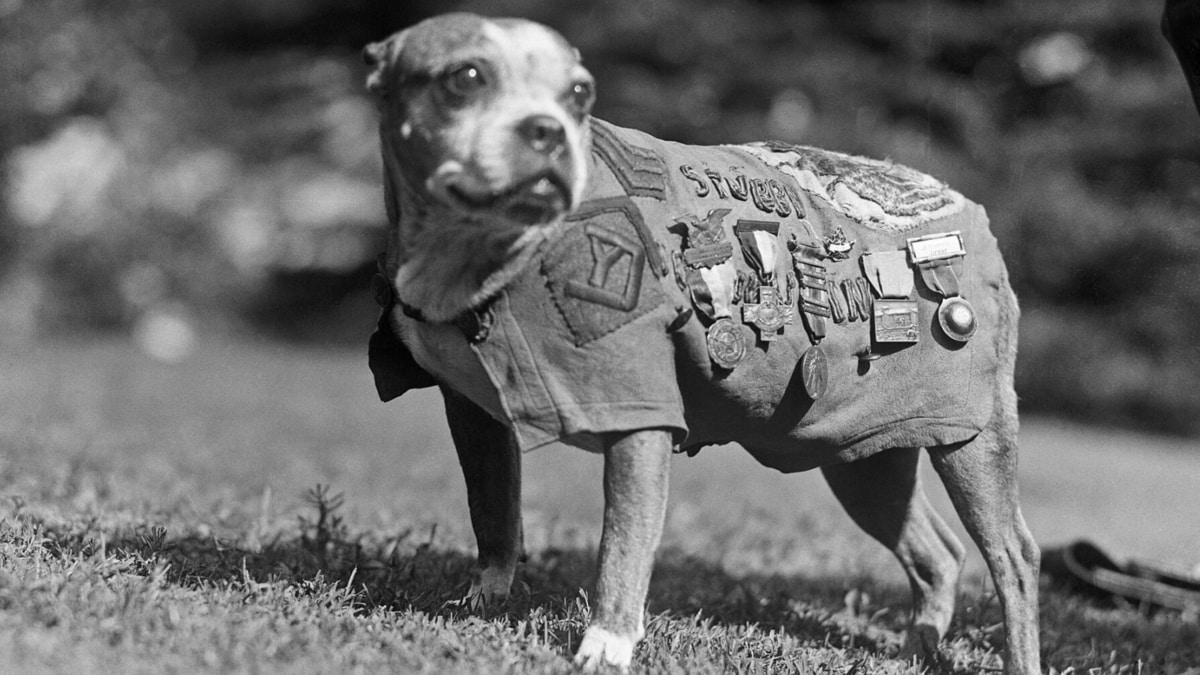
Stubby was a stray dog who wandered onto a military training camp at Yale University in 1917.
A soldier named James Robert Conroy became his friend.
Conroy secretly took Stubby with his unit to France during World War I. The army eventually allowed Stubby to stay after he reportedly saluted a commanding officer.
Stubby spent about 18 months near the fighting.
Soldiers said he warned them about poison gas and helped find wounded men.
He was hurt during the war and received several honors, including two Purple Hearts.
After returning home, Stubby became famous and later became part of a Smithsonian museum collection.

A stray dog found at Yale in July 1917 joined the U.S. Army’s 102nd Infantry Regiment.
Corporal James Robert Conroy secretly brought Stubby aboard the troop ship bound for France.
Stubby reportedly served for about 18 months, taking part in 17 battles and four offensives.
Accounts credit him with warning soldiers about mustard gas, locating wounded troops and helping capture a German soldier.
After the war, Stubby became a celebrity, met three U.S. presidents and was later preserved by the Smithsonian.
- Who
- Stubby, Corporal James Robert Conroy and the U.S. Army’s 102nd Infantry Regiment.
- What
- A stray dog served alongside American soldiers in World War I and was reportedly made a sergeant.
- When
- Stubby was found in July 1917, served for about 18 months, returned to the United States in 1918 and died in March 1926.
- Where
- He was found at Yale University, served on the Western Front in France and was later preserved by the Smithsonian.
- Why
- He attached himself to American soldiers and reportedly proved useful by warning of mustard gas, locating wounded soldiers and assisting during combat.
- Found
- July 1917 at Yale University
- Military unit
- U.S. Army’s 102nd Infantry Regiment
- Combat service
- About 18 months on the Western Front
- Reported involvement
- 17 battles and four offensives
- Honors
- A gold medal and two Purple Hearts
- Postwar recognition
- Met Presidents Woodrow Wilson, Calvin Coolidge and Warren G. Harding
- Final resting place
- Smithsonian collection at the National Museum of American History