

Archive · 12 Aug 2025
Study: Resource Shift Leads to Poverty Reduction in India
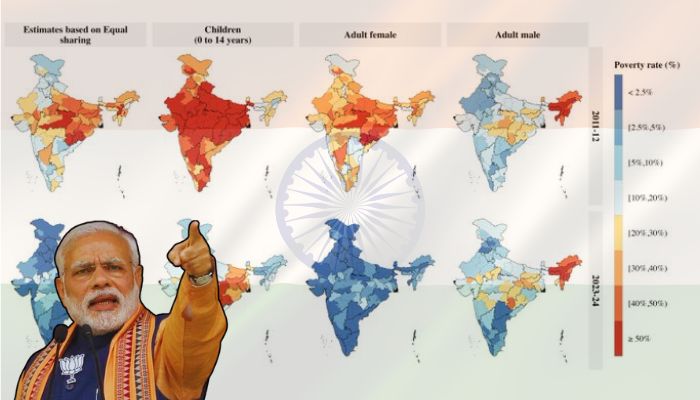
Between 2011 and 2023, lots of people in India got out of poverty.
This happened because families started sharing money and resources differently, especially helping women and children.
Women now have more say in how money is used.
Programs by the government helped women get their own money and property.
Overall, this has meant that fewer people are struggling to get by, showing that things are getting better for many families.

Study finds a significant shift in intra-household resource allocation in India between 2011 and 2023, leading to poverty reduction.
Over 27 crore people were lifted out of poverty, with women and children benefiting the most.
Poverty rates declined from 29.5% in 2011-12 to 4% in 2023-24 at the all-India level, assuming equal resource distribution.
Share of household resources to adult females increased, indicating increased bargaining power.
Government initiatives like Pradhan Mantri Awas Yojana and MUDRA Scheme have supported women's financial independence.
- Who
- Children, adult females, and adult males in India.
- What
- A study on how changes in how families share resources in India have led to a drop in poverty, especially for women and children.
- When
- Between 2011-12 and 2023-24.
- Where
- India
- Why
- To highlight the impact of changing resource allocation and government initiatives on poverty reduction.
Key Findings
N/A
Poverty Rates
Key Findings
Significant decline in poverty rates among women and children.
N/A
N/A
Resource Allocation
Key Findings
Increased share of household resources to adult females, especially in households with children.
N/A
N/A
- People Lifted Out of Poverty (2011-2024)
- 27.58 crore
- Poverty Rate in 2011-12 (All India)
- 29.5%
- Poverty Rate in 2023-24 (All India)
- 4%
- Children Lifted Out of Poverty
- 15.61 crore
- Adult Females Lifted Out of Poverty
- 12.32 crore
Sources
How gender remains a primary barrier to women’s workforce participation

How To Build Healthy Workplaces For Women: Ergonomics, Anaemia, Menopause & Other Risks