

Archive · 12 Jun 2025
Simushir Volcano's Ancient Eruption Altered Earth's Climate
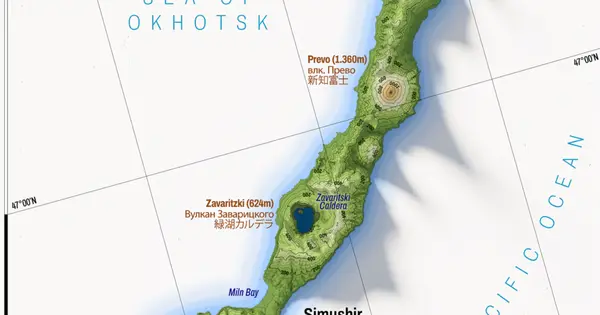
Long ago, a volcano on a Russian island called Simushir caused a big change in the Earth's climate.
Around 1831, it erupted and cooled down the Northern Hemisphere by about one degree.
Scientists later figured out the volcano was Zavaritski by studying ice from the North Pole.
The island is part of the Kuril Islands and used to be a secret base for Soviet submarines.
It's in a place called the 'Ring of Fire' where volcanoes are common.
This volcanic activity blocked the sun and made the sky look dark, changing the weather for a while.

A volcano on the Russian island of Simushir caused a significant climate change event nearly 200 years ago.
The eruption, which occurred around 1831, led to a cooling of the Northern Hemisphere by approximately 1 degree Celsius.
The exact volcano responsible was identified as Zavaritski through analysis of ash deposits in polar ice cores.
Simushir is part of the Kuril Islands, a volcanic region within the 'Ring of Fire', once a Soviet naval base.
The island was formerly a secret Soviet nuclear submarine base, but is uninhabited today.
- Who
- The volcano Zavaritski.
- What
- An eruption from a volcano on Simushir caused climate change.
- When
- Around 1831.
- Where
- Simushir, part of the Kuril Islands in the North Pacific Ocean.
- Why
- The eruption released ash, causing a cooling effect and altered the atmosphere.
- Location
- Simushir Island, Kuril Islands
- Volcano
- Zavaritski
- Approximate Eruption Year
- 1831
- Temperature Drop
- Approximately 1 degree Celsius in the Northern Hemisphere
- Former Use of Island
- Soviet nuclear submarine base