

Archive · 24 Sep 2026
Claude Helps Identify CRISPR-Like Enzyme System in 21 Hours

Anthropic says its Claude AI helped scientists find a biological system called ART.
ART was found in DNA linked to bacteriophages, which are viruses that infect bacteria.
The system includes an enzyme that copies information from RNA into DNA.
It also has repeating DNA patterns that look somewhat like patterns used by CRISPR.
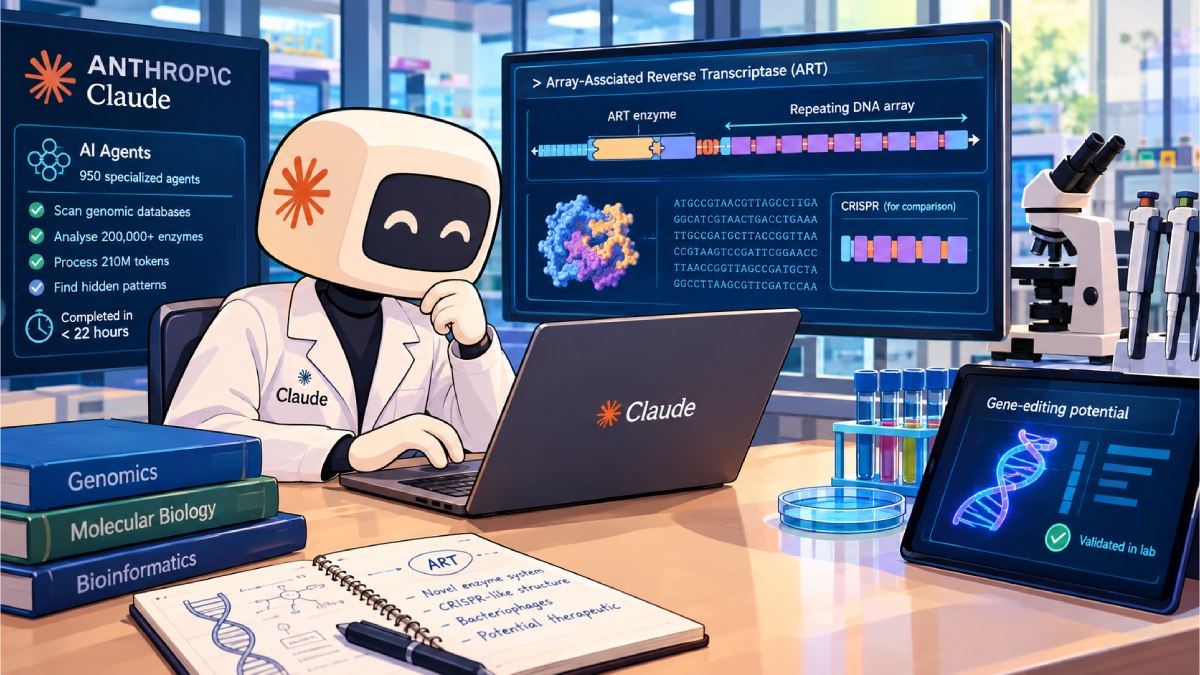
About 950 Claude agents searched more than 200,000 enzyme sequences in about 21 hours.
Human researchers then tested the idea in a laboratory.
They found that the repeated DNA makes short RNA molecules.
Scientists still do not know what ART does in nature.
It is not yet a gene-editing tool, and possible medical uses are only speculation.

Anthropic says Claude helped identify array-associated reverse transcriptases, or ART, in bacteriophage DNA.
About 950 Claude agents analyzed more than 200,000 reverse transcriptase sequences using roughly 210 million tokens over 21 hours.
ART combines a reverse transcriptase, a neighboring partner gene, and evenly spaced non-coding DNA repeats resembling CRISPR arrays.
Anthropic researchers validated that the repeats produce short RNA sequences in wet-lab experiments.
ART’s natural function and any possible gene-editing or medical applications remain unknown and speculative.
- Who
- Anthropic, its Claude model, and Anthropic researchers; Feng Zhang was cited as praising the finding.
- What
- The identification and laboratory investigation of a novel enzyme system called array-associated reverse transcriptases, or ART.
- When
- Anthropic announced the finding on a Wednesday; one supplied report was published September 24, 2026, and Claude’s analysis took about 21 hours.
- Where
- Claude searched large DNA databases, including bacteriophage sequences, and Anthropic conducted wet-lab validation in the San Francisco Bay Area.
- Why
- Anthropic is expanding into biology, life sciences, and drug-related research, while the system may offer a subject for future biological research.
Potential Scientific Breakthrough
Evidence Remains Preliminary
AI’s contribution
Potential Scientific Breakthrough
Anthropic says Claude recognized a broader biological system whose components had not previously been identified together, showing how AI could accelerate genomic research.
Evidence Remains Preliminary
The underlying reverse transcriptase had appeared in earlier studies, and the broader significance of ART has not yet been established.
Gene-editing potential
Potential Scientific Breakthrough
ART’s repeating DNA sequences resemble CRISPR arrays, raising the possibility that the system could eventually inform new programmable biological tools.
Evidence Remains Preliminary
ART has not been shown to edit genes, and any biotechnology or medical application remains speculative because its natural function is unknown.
Validation and significance
Potential Scientific Breakthrough
Human researchers confirmed in laboratory experiments that ART’s repeats produce short RNA sequences, supporting Claude’s hypothesis.
Evidence Remains Preliminary
The experiments confirmed this activity but did not establish what ART does in nature or demonstrate a usable therapeutic technology.
- Organization
- Anthropic
- AI model
- Claude
- System
- Array-associated reverse transcriptases (ART)
- Search scale
- More than 200,000 reverse transcriptase sequences
- AI operation
- About 950 Claude agents working for roughly 21 hours
- Computing used
- Approximately 210 million tokens
- Laboratory finding
- The ART repeats produced short RNA sequences
- Research status
- ART’s natural function and potential applications remain unclear
Sources
Anthropic says Claude AI helped discover novel enzyme system
Claude discovers new gene-editing tool in 21 hours: What this breakthrough means for science
Anthropic Says Claude AI Helped Discover Novel Enzyme System
Anthropic's Claude Discovers New Enzyme System That Could Rewrite The Future Of Gene Editing: Here's Why It's A Big Deal