Archive · 2 Sep 2026
Maharashtra Approves Multi-Department Plan for Drug-Free State by 2029
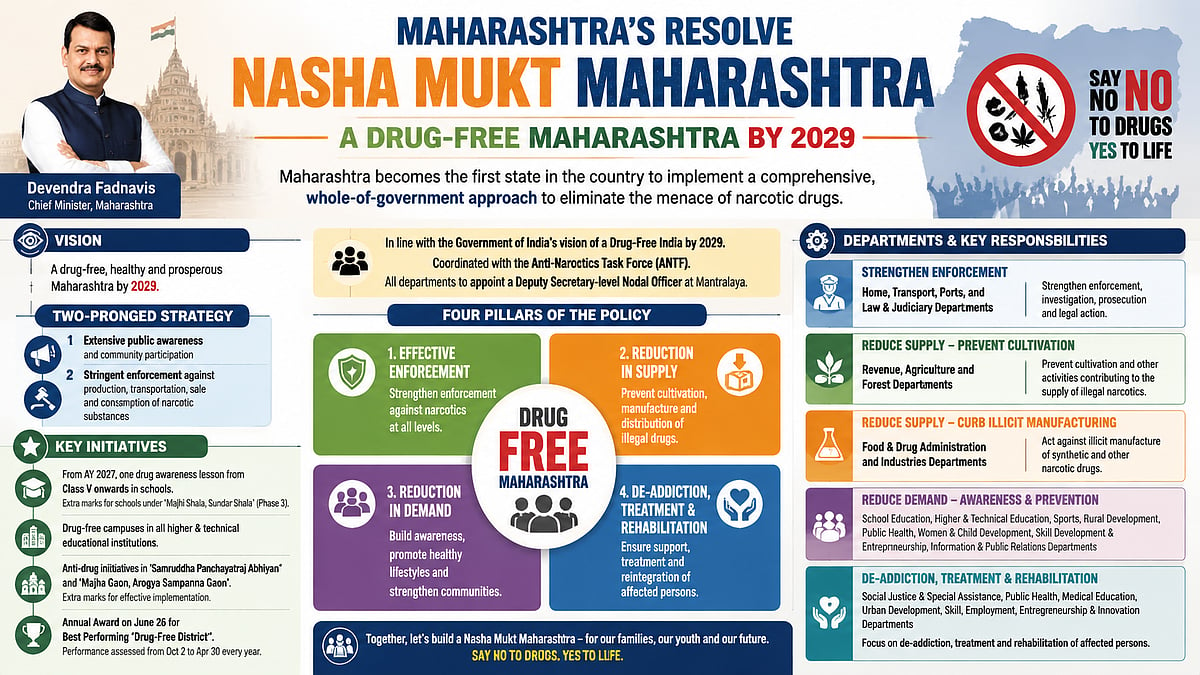
Maharashtra’s government wants to make the state free of narcotic drugs by 2029.
The Cabinet approved a plan involving 20 government departments.
Officials will work to stop illegal drug production, transport, sales and cultivation.
Schools will teach children about the dangers of drugs from Class V starting in the 2027-28 school year.
The government also plans to create drug-free areas around educational institutions.
People affected by drug use are to receive de-addiction, treatment and rehabilitation services.
Police and other agencies will share information and use tools such as artificial intelligence and darknet monitoring to investigate drug networks.
Each year, the government will recognize the district that performs best in fighting drugs.

The Maharashtra Cabinet approved a whole-of-government policy targeting a drug-free state by 2029.
The plan involves 20 departments and combines enforcement, supply reduction, awareness, treatment and rehabilitation.
Schools will introduce at least one drug-awareness lesson from Class V beginning in the 2027-28 academic year.
The government plans drug-free zones within 500 metres of educational institutions and encourages drug-free campuses.
Districts will be assessed annually, with the best-performing Drug-Free District receiving an award on June 26, 2027.
- Who
- The Maharashtra state government, led at the meeting by Chief Minister Devendra Fadnavis, with 20 departments and agencies involved.
- What
- Approved a comprehensive anti-narcotics policy to make Maharashtra drug-free by 2029.
- When
- The policy was approved on Tuesday; school lessons are planned from the 2027-28 academic year, and a district campaign is planned from October 2, 2026, to May 2027.
- Where
- Across Maharashtra, from villages and districts to the state Secretariat, with a proposed rehabilitation centre in Mumbai.
- Why
- To reduce drug supply and demand, strengthen enforcement, and provide de-addiction, treatment and rehabilitation.
- Target
- Maharashtra aims to become free of narcotic drugs by 2029.
- Departments involved
- The whole-of-government policy involves 20 departments from the village level to the state level.
- Four pillars
- Effective enforcement, drug-supply reduction, demand reduction, and de-addiction, treatment and rehabilitation.
- School education
- At least one drug-awareness lesson will be introduced from Class V in the 2027-28 academic year.
- Drug-free zones
- The government plans to establish drug-free zones within a 500-metre radius of educational institutions.
- District award
- The best-performing Drug-Free District is scheduled to receive an annual award on June 26, 2027.
- Enforcement tools
- The plan includes exclusive NDPS courts, special public prosecutors, artificial-intelligence analysis, darknet monitoring and an integrated NDPS dashboard.