

Archive · 5 Nov 2025
NASA's ESCAPADE Mission Launches Twin Orbiters to Mars
Imagine Mars used to have a big blanket of air, like Earth.
But over a long time, the sun's wind blew most of that air away, leaving it cold and dry.
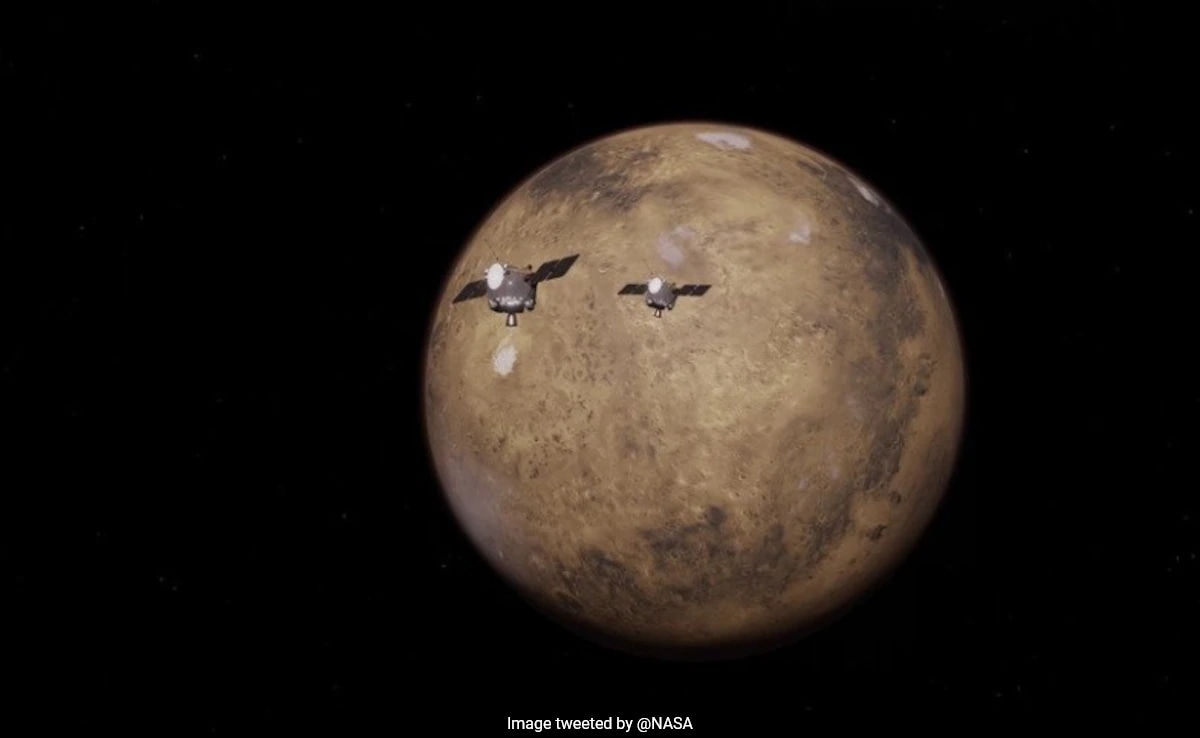
NASA is sending two identical spaceships, called ESCAPADE, to Mars.
These twin ships will fly around Mars at the same time but in slightly different paths.
This helps scientists see exactly how the sun's wind interacts with Mars' magnetic field.
By measuring this, they hope to learn how Mars lost its air and became the planet it is today.
It's like having two eyes to get a clearer picture of what's happening.
The spaceships will also study space weather on their way to Mars.
This is NASA's first time sending two science ships like this to Mars at once.
The mission will launch on a big rocket called New Glenn.

NASA's ESCAPADE mission, with twin orbiters named Blue and Gold, is set to launch on November 9 aboard Blue Origin's New Glenn rocket.
The mission aims to study how solar wind interacts with Mars' magnetosphere and causes atmospheric loss, helping understand Mars' climate history.
ESCAPADE is NASA's first dual-spacecraft orbital science mission to Mars, using complementary orbits for 3D measurements.
The twin probes will spend a year orbiting Earth's L2 point before a 10-month journey to Mars, arriving in September 2027.
The mission is a significant flight for Blue Origin's New Glenn rocket, marking its second launch and first interplanetary mission.
- Who
- NASA
- What
- Launching twin orbiters, Blue and Gold, to study Mars' magnetosphere and atmospheric loss.
- When
- Launch on November 9, with Mars arrival expected in September 2027.
- Where
- Launching from Cape Canaveral Space Force Station, with the mission focused on Mars.
- Why
- To understand how solar wind interacts with Mars' magnetic field, causing atmospheric loss and shaping its climate history.
- Mission Name
- ESCAPADE (Escape and Plasma Acceleration and Dynamics Explorers)
- Spacecraft
- Twin orbiters: Blue and Gold
- Launch Date
- November 9
- Launch Vehicle
- Blue Origin's New Glenn rocket
- Primary Objective
- Study Mars' magnetosphere and atmospheric loss
- Mission Lead
- UC Berkeley's Space Sciences Laboratory
- Mars Arrival (Expected)
- September 2027