

Archive · 3 Oct 2026
CJI Kant Says AI Can Aid Courts, Not Replace Judges
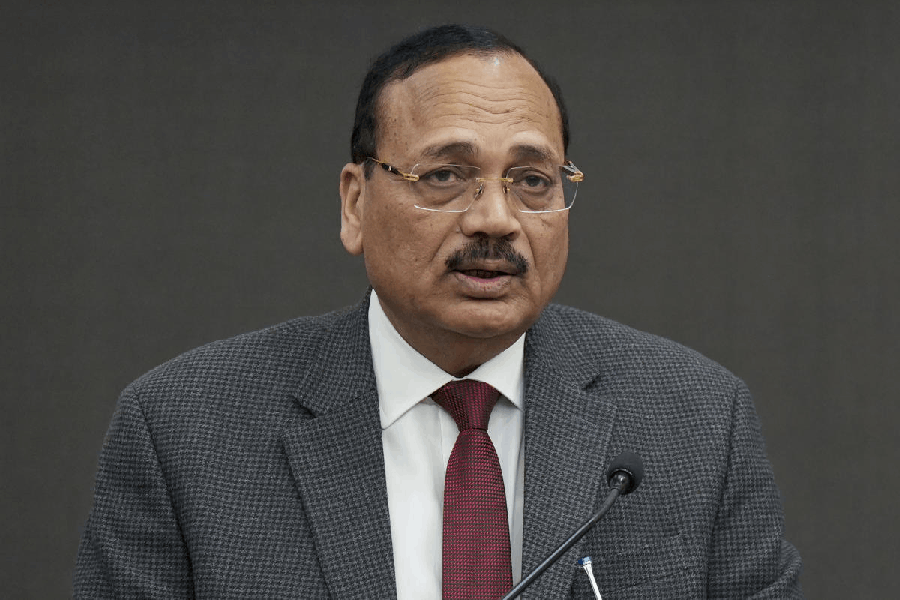
Chief Justice Surya Kant said computers and artificial intelligence can help courts do some tasks.
But judges must make the important legal decisions themselves.
He said court technology should help people reach justice, not leave some people out.
Online filing and video hearings can make it easier to take part in court.
The Supreme Court has also used tools to translate judgments and share case information.
Kant said technology must respect people’s rights and keep court information safe.
He also said courts need to address unequal access to technology and make sure computer systems are accountable.

Chief Justice of India Surya Kant said AI can assist judicial research and court processes, but judges must retain decision-making authority.
Speaking in Samarkand, he said digitisation should expand access to justice while upholding constitutional guarantees and public trust.
Kant described e-filing, virtual hearings, digital case management and live-streaming as ways technology can reduce barriers of distance and cost.
He cited over 750,000 Supreme Court video-conference hearings from March 2020 to June 2024, plus translation and chatbot services.
He identified the digital divide, data security and algorithmic accountability as challenges requiring safeguards and cooperation among Asian courts.
- Who
- Chief Justice of India Surya Kant.
- What
- He said AI may support judicial research and court processes but cannot replace judges’ legal judgment or decision-making.
- When
- Thursday; the PTI report is dated October 1.
- Where
- Samarkand, Uzbekistan, at events on constitutional courts and digitising justice.
- Why
- To explain how courts can use technology to improve access to justice while preserving constitutional guarantees, human decision-making and public trust.
Human Judicial Authority
Technology-Enabled Access
AI’s role in court
Human Judicial Authority
AI can assist research and court processes, but legal acumen and decisions must remain with judges.
Technology-Enabled Access
Digital tools can support court services, case information and access to proceedings; the reports do not advocate replacing judges.
Benefits and safeguards
Human Judicial Authority
Use of technology must preserve constitutional guarantees, address security and accountability risks, and avoid undermining public trust.
Technology-Enabled Access
E-filing, virtual hearings and digital case management can reduce distance- and cost-related barriers and help make justice more accessible.
- Speaker
- Chief Justice of India Surya Kant
- AI principle
- AI may support judicial research and court processes, but judges retain decision-making authority.
- Constitutional guarantees cited
- Articles 21, 14 and 32; the PTI report also cites Article 39A on free legal aid.
- Video hearings
- The Supreme Court held over 750,000 video-conference hearings between March 2020 and June 2024.
- SUVAS
- The AI-assisted translation tool had published more than 83,000 translations in 18 languages by the previous year, according to Kant.
- Su-Sahayak
- An AI-powered chatbot that provides information on case status, cause lists, orders, judgments and e-services.
- Risks identified
- The digital divide, data security and algorithmic accountability.
