

Archive · 17 Jun 2025
Unusual Comet Discovered Far from Sun, Baffles Scientists
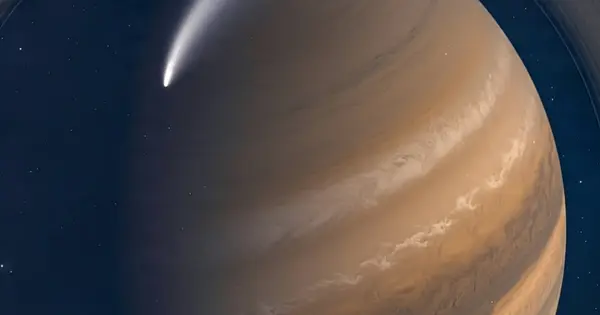
Imagine a comet, like a giant icy snowball, that's supposed to wake up and grow a tail when it gets close to the sun.
But this one, called Comet Gröller, is acting weird.
It's really far away from the sun, even further than Earth, yet it's still active.
Scientists are puzzled because it's not supposed to have a tail so far out.
They think it might have special ingredients, like different types of ice or super-rare stuff.
This comet could help us learn about the beginning of our solar system, when the sun was just a baby, and even how the universe formed after the Big Bang.

A comet, C/2025 D1 (Gröller), has been discovered orbiting between Saturn and Uranus.
The comet is 14.1 AU from the Sun, much further than where comets typically become active.
Comet Gröller has scientists baffled due to its unusual activity at such a distance.
Experts suggest the comet might contain chemical compounds or supervolatiles not usually found in comets.
The comet could offer insights into the early solar system, dating back 4.6 billion years.
- Who
- Discovered by Hannes Gröller, an astronomer, and baffling scientists.
- What
- An unusual comet, C/2025 D1 (Gröller), exhibiting unexpected activity.
- When
- The comet was discovered recently.
- Where
- Orbiting between Saturn and Uranus, 14.1 AU from the Sun.
- Why
- To understand the composition of the early solar system and the universe's origins.
Scientists' Theories
Early Solar System Insights
Comet Composition
Scientists' Theories
The comet may contain compounds like carbon monoxide or carbon dioxide.
Early Solar System Insights
The comet may contain supervolatiles that do not exist in bodies near the inner solar system.
- Comet Name
- C/2025 D1 (Gröller)
- Discovery
- By Hannes Gröller using the Catalina Sky Survey
- Location
- Between Saturn and Uranus
- Distance from Sun
- 14.1 AU (2.1 billion kilometers)
- Anomaly
- Active at a far distance from the Sun
- Possible Composition
- Chemical compounds or supervolatiles