Archive · 3 Dec 2025
Pune Researchers Discover Ancient Spiral Galaxy
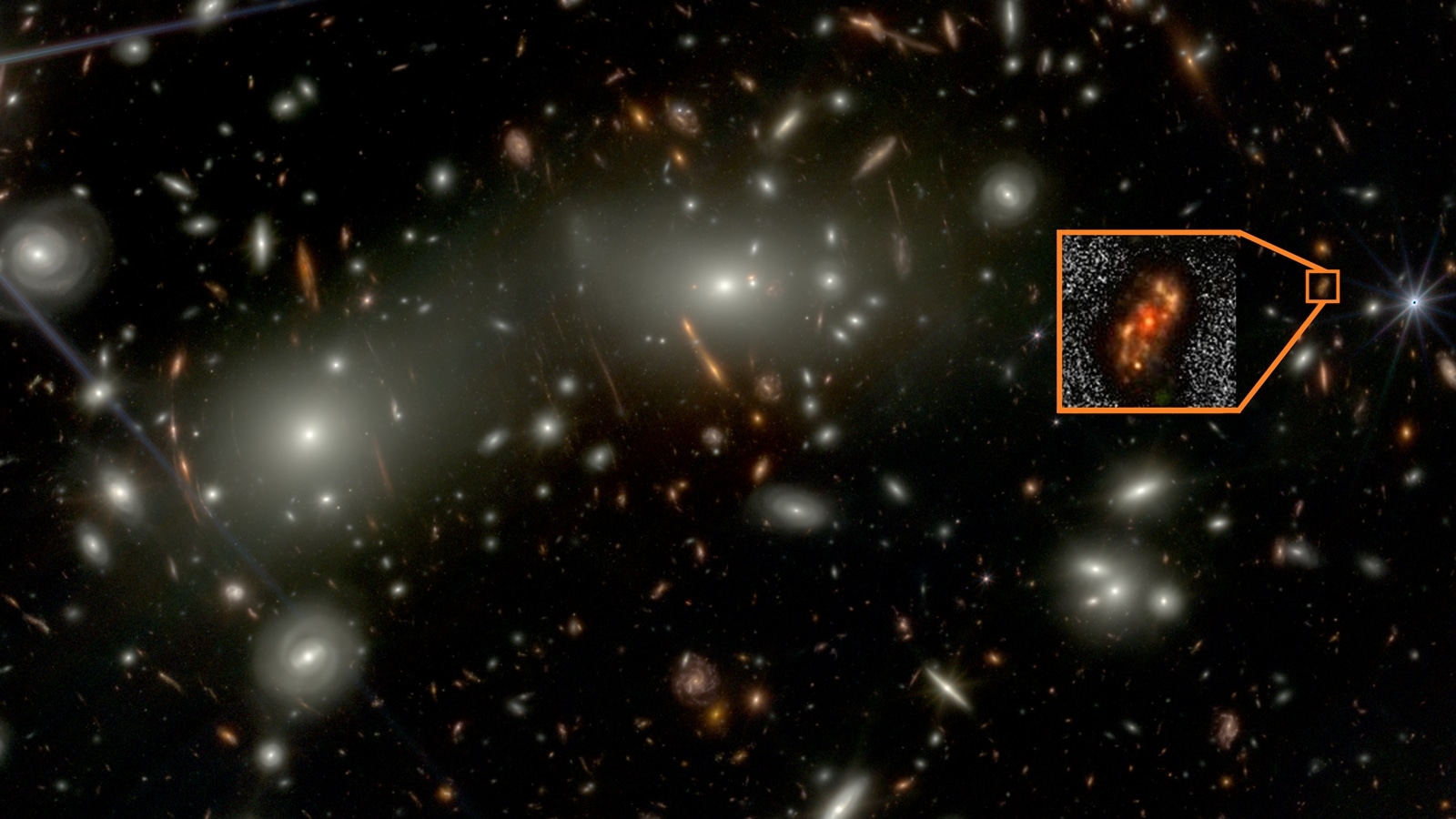
Scientists in Pune, India, found a very old galaxy called Alaknanda.
This galaxy is special because it looks like a spiral, similar to our Milky Way, even though it existed when the universe was very young.
Usually, galaxies from that time are thought to be messy and not well-formed.
The discovery was made using a powerful telescope called the James Webb Space Telescope.
The researchers named it Alaknanda after a river in the Himalayas.
This finding suggests that the early universe might have been more developed than scientists previously believed.
The next step is to study the movements of gas and stars in this galaxy to understand how it formed.

Researchers from Pune discovered a spiral galaxy named Alaknanda that existed when the universe was 1.5 billion years old.
Alaknanda has a well-defined spiral structure similar to the Milky Way, challenging current theories about early galaxy formation.
The discovery was made using NASA's James Webb Space Telescope (JWST).
Alaknanda is located about 12 billion light-years away and spans approximately 30,000 light-years in diameter.
The findings suggest that the early universe was more mature than previously thought, with sophisticated structures forming earlier than expected.
- Who
- Researchers Rashi Jain and Yogesh Wadadekar from the National Centre for Radio Astrophysics (NCRA-TIFR) in Pune, India
- What
- Discovered a well-defined spiral galaxy named Alaknanda
- When
- The galaxy existed when the universe was 1.5 billion years old
- Where
- The galaxy is located 12 billion light-years away
- Why
- To study the formation and structure of early galaxies
Traditional View
New Evidence
Early Galaxy Formation
Traditional View
Early galaxies were chaotic and clumpy, with stable spiral structures emerging only after several billion years.
New Evidence
The discovery of Alaknanda suggests that sophisticated structures like spiral arms formed much earlier than previously thought, indicating the early universe was more evolved.
- Galaxy Name
- Alaknanda
- Age of the Universe
- 1.5 billion years old
- Distance from Earth
- 12 billion light-years
- Galaxy Diameter
- 30,000 light-years
- Observation Tool
- James Webb Space Telescope (JWST)
- Research Institution
- National Centre for Radio Astrophysics (NCRA-TIFR), Pune
- Journal
- Astronomy and Astrophysics
- Star Formation Rate
- 63 solar masses per year
- Redshift
- 4
- Researchers
- Rashi Jain and Yogesh Wadadekar
Sources
Pune researchers find spiral galaxy like Milky Way from early universe

Daily Briefing: Behind Sanchar Saathi backlash

Pune researchers find massive, grand-design spiral galaxy existing since universe's infancy

How did ancient galaxy Alaknanda get spiral arms?