

Archive · 10 Nov 2025
Kerala Declared India's First Extreme Poverty-Free State
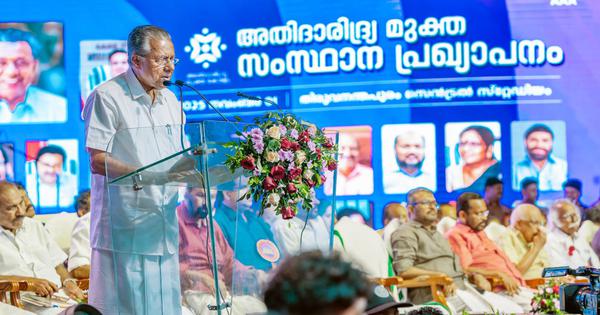
Imagine a state called Kerala in India wanted to make sure absolutely no one was left behind without basic needs.
They launched a special program to find people who were so poor they weren't even getting help from normal programs, like people with no homes or serious illnesses.
To find them, helpers from the government, doctors, and neighbors looked everywhere, talking to people to understand who needed help.
They found over 100,000 people in about 64,000 families who were in this very difficult situation.
For each family, they made a special plan, like building a house, giving money for a small business, or providing medical care.
This way, Kerala is saying it has taken care of its poorest citizens.
While some people think this is a great step, others wonder if it truly fixed all the problems of being poor forever or if the numbers might have been even bigger.

Kerala announced itself as India's first state to eradicate extreme poverty on November 1.
The Extreme Poverty Eradication Programme, launched in May 2021, identified 103,099 individuals in 64,006 households as 'athidaridrar' (extremely poor).
Identification involved extensive community outreach, multi-departmental collaboration, and local knowledge to find those missed by existing welfare schemes.
Tailored micro-plans addressing specific vulnerabilities, including housing, livelihoods, and medical care, were developed for each identified family.
While hailed as a landmark, the initiative faces criticism regarding its methodology, definitions, and whether it constitutes a genuine eradication or a managerial exercise.
- Who
- Kerala government and its citizens
- What
- Declaration of the state as the first in India to eradicate extreme poverty through the Extreme Poverty Eradication Programme
- When
- Announced on November 1, following a programme launched in May 2021
- Where
- Kerala, India
- Why
- To identify and address the needs of individuals and families excluded from existing welfare schemes and lift them out of destitution.
Supporters' View
Critics' View
Definition and Scope of Extreme Poverty
Supporters' View
The initiative successfully identified and addressed the needs of individuals and families excluded from existing welfare schemes due to reasons like homelessness, mental illness, or lack of working-age members.
Critics' View
Critics question equating 'athidaridrar' with the statistically defined 'extremely poor' category, suggesting it might be an obfuscatory, managerial exercise or a publicity stunt by declaring a limited number of families as the only ones suffering from extreme poverty.
Methodology and Identification
Supporters' View
The identification process leveraged extensive outreach mechanisms, community knowledge, and multi-departmental collaboration, including health, education, and local governance, to physically locate and assess individuals.
Critics' View
The methodology might have underestimated the numbers of 'athidaridrar', suggesting the exercise may need to be repeated or expanded, and the automatic mapping of 'athidaridrar' to 'extremely poor' clashes with existing definitions for other interventions.
Impact and Approach to Poverty Eradication
Supporters' View
The intervention provided tailored micro-plans for each family, addressing specific vulnerabilities with multi-pronged measures such as housing, livelihood support, and medical treatment, restoring dignity to the excluded.
Critics' View
The exercise, while reaching the excluded, may not fundamentally address deeper structural causes of inequality and poverty, potentially limiting its long-term transformative impact.
- Date of Declaration
- November 1
- Programme Name
- Extreme Poverty Eradication Programme
- Launch Date
- May 2021
- Identified Extremely Poor Individuals
- 103,099
- Identified Extremely Poor Households
- 64,006
- Kerala's Poverty Rate (Niti Aayog 2023)
- 0.55%
- National Poverty Rate (Niti Aayog 2023)
- 14.95%