

Archive · 19 Jun 2025
Earth's Ancient Hues: From Purple and Pink to Blue
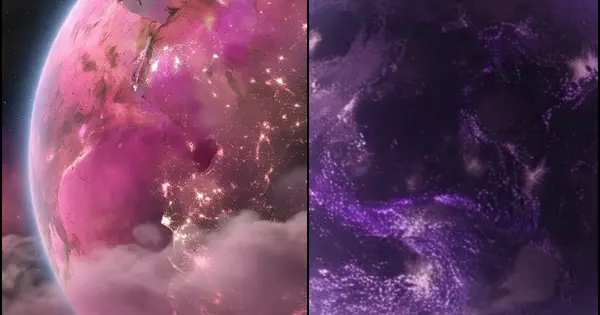
Imagine Earth was once not blue but a different colour!
Scientists think the oceans may have been purple or even pink billions of years ago.
Early life used a molecule called retinal, making the planet look purple.
Later, cyanobacteria made the oceans pink.
Eventually, plants using chlorophyll became dominant, and the oceans turned blue as we know them today.

Earth's oceans may have been purple or pink billions of years ago.
The 'Purple Earth Hypothesis' suggests early life used retinal, reflecting red and blue light.
Retinal is found in halobacteria, which appear purple.
Cyanobacteria, containing pink pigment, gave Earth a pinkish hue over 650 million years ago.
Chlorophyll eventually became dominant due to its efficiency.
- Who
- Shiladitya DasSarma proposed the theory.
- What
- Earth's oceans may have been purple and pink billions of years ago.
- When
- Between 3.5 and 2.4 billion years ago, and over 650 million years ago.
- Where
- Earth's oceans and the Sahara Desert in Mauritania, West Africa.
- Why
- Different molecules dominated the Earth's early life.
Scientific Theories
Scientific Discoveries
Earth's color evolution
Scientific Theories
Early Earth's color was influenced by microbes and the molecules they utilized.
Scientific Discoveries
Current scientific consensus suggests Earth has shifted over time.
- Hypothesis
- Purple Earth Hypothesis
- Key Molecule (Early Earth)
- Retinal
- Key Molecule (Later Earth)
- Chlorophyll
- Ancient Bacteria with Pink Pigment
- Cyanobacteria
- Oldest Known Color
- Pink