

Archive · 1 Jan 2026
Earth's Rotation Slowing: 25-Hour Days Possible
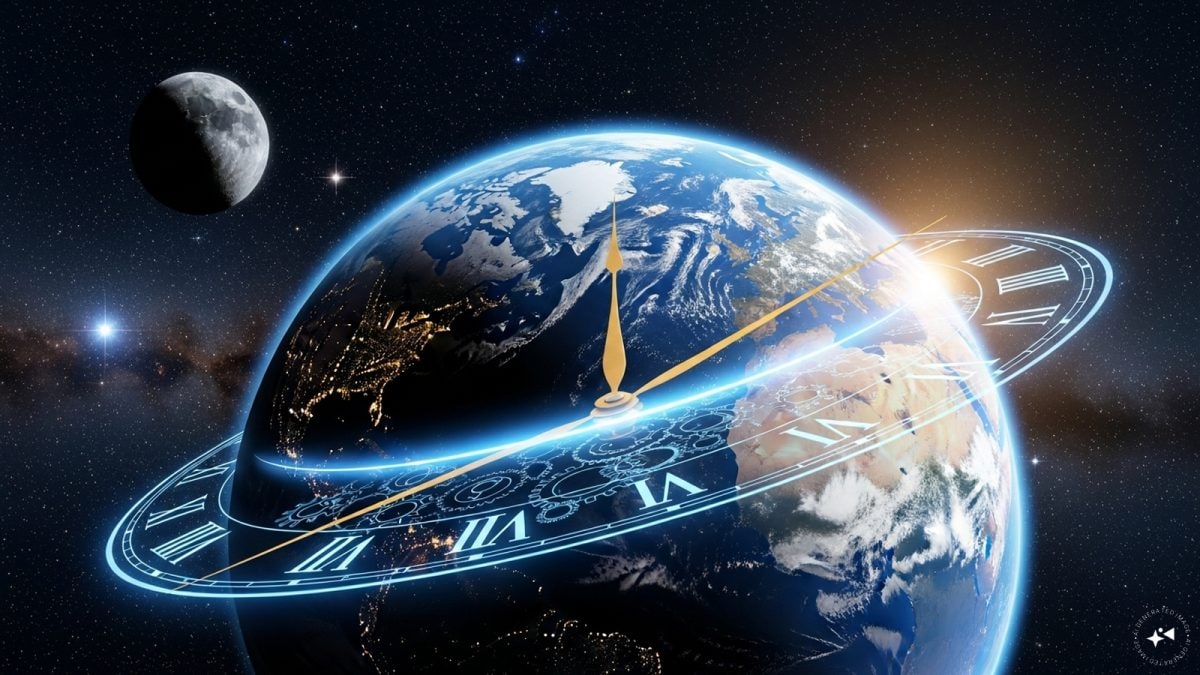
Scientists have found that Earth is spinning a little slower every year.
This means that in the very far future, a day on Earth might last 25 hours instead of 24.
The main reason for this is the Moon's gravity, which acts like a brake on Earth's spin.
Climate change is also making the days a tiny bit longer because melting ice and changing water levels affect how Earth spins.
Even though this change is very slow, it shows that our planet is always changing.
Don't worry, though—it will take about 200 million years for a day to become 25 hours long, so we won't notice any difference in our lifetimes.

Earth's rotation is slowing down by milliseconds per century due to the Moon's gravitational pull and climate change.
The Moon moves away from Earth at a rate of 3.8 cm per year, contributing to the slowing rotation.
Melting ice sheets and redistributing Earth's mass due to climate change add fractions of a millisecond to each day.
Scientists use advanced geodesy techniques and machine-learning tools to measure Earth's rotation with precision.
It could take around 200 million years for a day to lengthen from 24 to 25 hours.
- Who
- Scientists and researchers
- What
- Earth's rotation is slowing down
- When
- Gradual process over millions of years
- Where
- Earth
- Why
- Due to the Moon's gravitational pull, climate change, and internal Earth changes
- Current Slowing Rate
- Milliseconds per century
- Moon's Distance Increase
- 3.8 cm per year
- Timeframe for 25-Hour Day
- Approximately 200 million years
- Measurement Tools
- Radio signals, satellite laser ranging, atomic clocks
- Influence of Climate Change
- Melting ice sheets and redistributing Earth's mass
- Solar Day vs Sidereal Day
- Solar day is 4 minutes longer than sidereal day