

Archive · 19 May 2025
India's HAP Prototype Completes Key Tests for Border Patrol
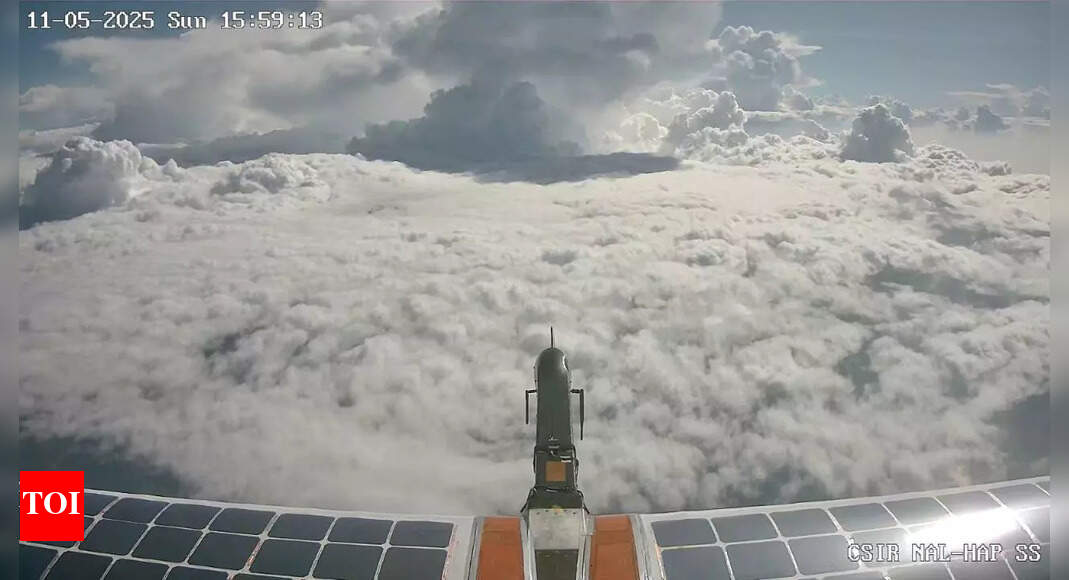
India is testing a special solar-powered drone called HAP to watch its borders.
It flies very high, above the clouds.
Recently, the HAP was tested with a new autopilot system, which lets it fly all by itself.
The tests checked how well it works, especially when the sun is hidden by clouds.
This drone can fly for many hours and cover a lot of ground, making it useful for patrolling borders.
It could also be used for things like weather monitoring and helping with cell phone signals.
The full-size version is expected to be ready for testing by 2026.

NAL's HAP prototype completed crucial flight tests with an upgraded autopilot system.
The solar-powered vehicle navigated through cloud cover during the tests.
The tests were conducted at the Aeronautical Test Range (ATR) in Challakere, India.
The HAP subscale prototype can patrol hundreds of miles of borders autonomously.
The Indian Air Force (IAF) is seeking similar high-altitude platform systems.
- Who
- The National Aerospace Laboratories (NAL) developed the HAP prototype.
- What
- NAL's HAP prototype completed flight tests with an upgraded autopilot system.
- When
- Between May 8 and 13, the tests were carried out.
- Where
- The tests were carried out at the Aeronautical Test Range (ATR) in Challakere, India.
- Why
- To boost India's border security infrastructure and surveillance technology.
- Project Name
- High-Altitude Platform (HAP)
- Organization
- National Aerospace Laboratories (NAL)
- Test Location
- Aeronautical Test Range (ATR), Challakere, India
- Test Dates
- May 8-13
- Altitude Achieved
- 24,000 feet
- Full-Scale HAP Target Launch
- First quarter of 2026