

7 months ago
Cosmic Hamburger Reveals Planet Formation Signs
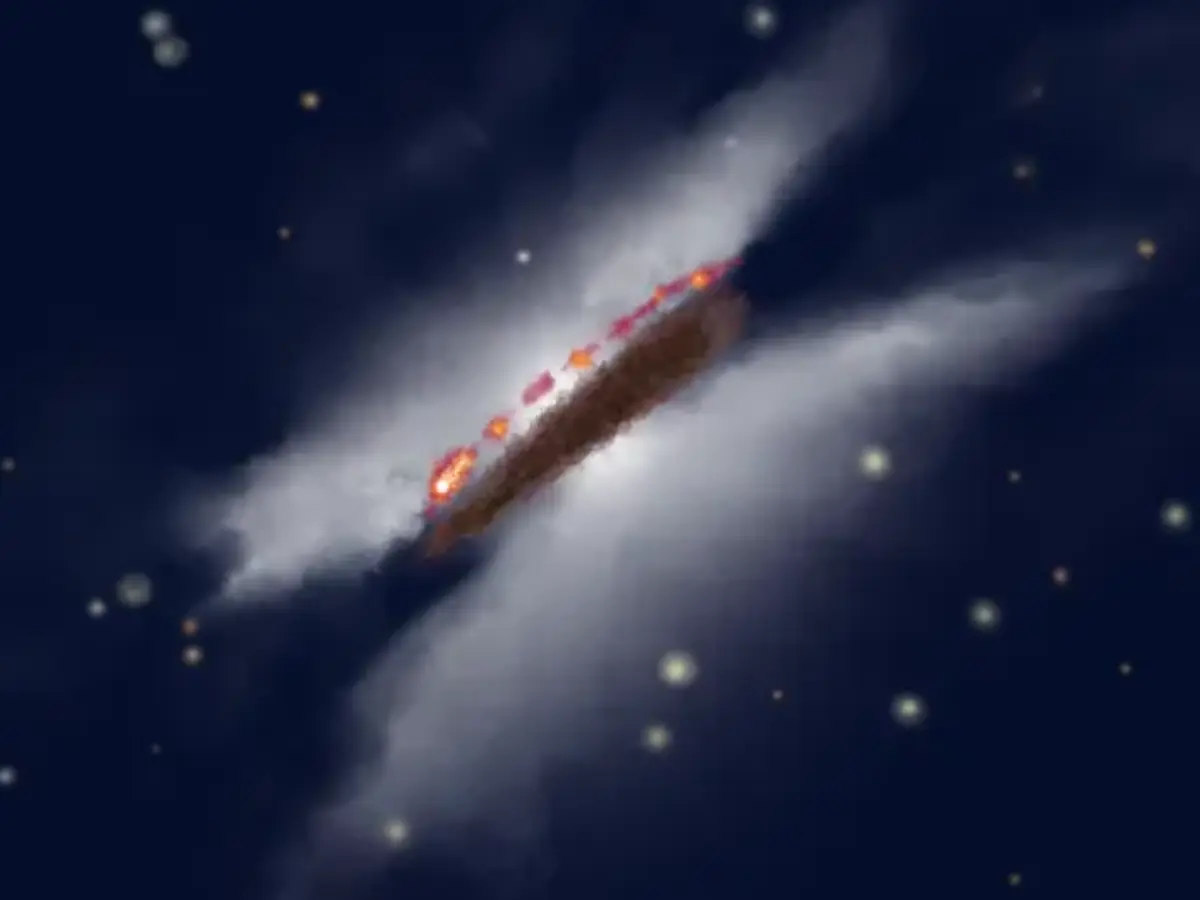
Scientists have discovered a huge disk of gas and dust in space, called Gomez's Hamburger (GoHam), that looks like a burger from Earth.
This disk is so big that it's the largest of its kind ever seen.
The scientists used a powerful tool called ALMA to study it.
They found that planets might be forming inside this disk.
The disk has layers of gas that look like the buns of a burger, and the dust is in the middle.
Studying GoHam helps scientists understand how planets are born and how they change the gas and dust around them.

Gomez's Hamburger (GoHam) is a massive protoplanetary disk with signs of planet formation.
The disk appears like a burger with gas layers as 'buns' and dust in the middle.
GoHam is the largest protoplanetary disk ever observed, with a width of 2,000 times the distance between the sun and Earth.
Scientists used the ALMA array in northern Chile to study the disk.
GoHam provides a unique opportunity to study how disks evolve and form planets.
- Who
- Scientists led by Charles Law of the University of Virginia
- What
- Detected signs of planet formation in Gomez's Hamburger (GoHam)
- Where
- Observed through ALMA in northern Chile
- When
- Not specified
- Why
- To understand disk evolution and planet formation
Key facts
- Object Name
- Gomez's Hamburger (GoHam)
- Type
- Protoplanetary disk
- Observation Tool
- Atacama Large Millimeter/submillimeter Array (ALMA)
- Location
- Northern Chile
- Disk Width
- 2,000 times the distance between the sun and the Earth
- Disk Height
- Several 100 times the distance between the sun and the Earth
- Lead Researcher
- Charles Law, University of Virginia
Quotes
Charles Law
Lead researcher and astronomer at the University of Virginia
“GoHam is the perfect laboratory for understanding how giant planets can form far from their star because of the combination of extreme disk size, strong asymmetries, winds, and potential planet formation.”
 wionews.com
“GoHam gives us a rare and clear view of the vertical and radial structure of a very large, nearly edge‑on disk.”
wionews.com