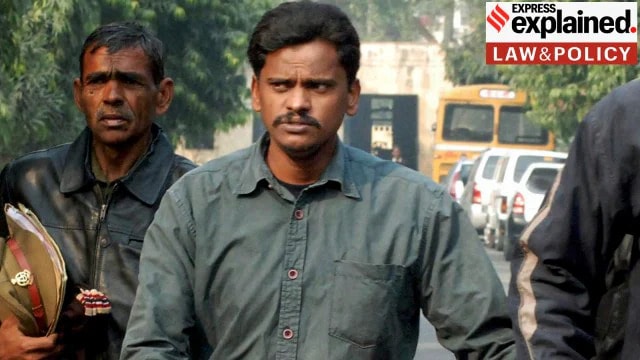
Archive · 15 Nov 2025
Supreme Court Acquits Surendra Koli in Nithari Case, Cites Evidence Discrepancy

Imagine someone was found guilty of a very serious crime and sentenced to a long punishment.
However, for other similar crimes, using almost the same proof, different judges said he was not guilty.
The highest court in the country saw this problem and said it wasn't fair or right to have two completely different decisions when the evidence was the same.
This is like saying someone is guilty of one thing but innocent of a very similar thing with the same proof.
The court decided this couldn't stand because it made the justice system seem unreliable.
So, they used a special power called a curative petition to review the case and fix this big mistake.
Because of this, the person was eventually freed after the court acknowledged the contradictory verdicts.

Surendra Koli has been acquitted by the Supreme Court in a rape and murder case related to the Nithari killings, overturning a previous 2011 decision.
The acquittal was granted through a curative petition, an extraordinary legal remedy used when there's a violation of natural justice.
The court cited a 'fundamental defect,' noting that Koli's conviction in this case conflicted with his acquittals in 12 other Nithari cases based on identical evidence.
These acquittals in companion cases were based on the rejection of Koli's confession, deemed unreliable due to prolonged police custody and allegations of torture.
The Supreme Court's intervention aimed to correct a grave error, preserve the integrity of the judicial process, and prevent manifest injustice arising from contradictory verdicts.
- Who
- Surendra Koli, accused in the Nithari killings
- What
- The Supreme Court acquitted Surendra Koli in a rape and murder case, overturning its own 2011 decision based on a curative petition that highlighted contradictions with his acquittals in 12 other Nithari cases stemming from the same evidence.
- When
- The Supreme Court acquitted Koli this week; the ruling followed acquittals in 12 companion cases in July 2025; original conviction in this case was in 2011.
- Where
- India (Nithari village, Noida)
- Why
- The Supreme Court intervened via a curative petition, citing a fundamental defect where conviction in one case could not lawfully coexist with acquittals in other similar cases based on the same evidence, thereby preventing a miscarriage of justice and upholding the rule of law.
Supreme Court's Curative Petition Ruling
Original Conviction and Lower Court Decisions
Conflicting Verdicts
Supreme Court's Curative Petition Ruling
The Supreme Court acknowledged a fundamental defect, stating that Koli's conviction in one case could not lawfully coexist with his acquittal in 12 other Nithari cases based on the same evidence, deeming it a miscarriage of justice.
Original Conviction and Lower Court Decisions
Koli was initially convicted and sentenced to death by a trial court in the Rimpa Haldar case, a verdict later upheld by the Allahabad High Court and the Supreme Court before his sentence was commuted to life imprisonment in 2015 due to inordinate delay in mercy petition processing.
Evidence Reliability
Supreme Court's Curative Petition Ruling
The Supreme Court highlighted that the acquittals in the 12 companion cases were based on the same evidence (a 2007 confession and 2006 recoveries), with the Allahabad High Court in 2023 deeming the confession unreliable due to Koli being in police custody for 60 days without legal access and allegations of tutoring and torture.
Original Conviction and Lower Court Decisions
The original conviction in the Rimpa Haldar case was based on Koli's 2007 confession and 2006 recoveries, suggesting that at the time, the evidence was considered sufficient for a conviction.
Judicial Remedy and Integrity
Supreme Court's Curative Petition Ruling
The Supreme Court entertained the curative petition to correct a grave defect and avert manifest injustice, emphasizing the need to preserve the purity of the court's process and vindicate the rule of law when similar evidence leads to contradictory outcomes.
Original Conviction and Lower Court Decisions
After appeals and review petitions were dismissed, and mercy petitions rejected, Koli was facing the finality of his conviction in the Rimpa Haldar case, with his death sentence commuted to life imprisonment.
- Accused
- Surendra Koli
- Case Series
- Nithari Killings
- Initial Conviction (Rimpa Haldar Case)
- Death sentence by trial court (2009)
- Sentence Commutation (Rimpa Haldar Case)
- Life imprisonment by Allahabad HC (2015)
- Acquittals in Companion Cases
- 12 cases by Allahabad HC (2023), upheld by Supreme Court (July 2025)
- Curative Petition Basis
- Conflicting verdicts on same evidence; violation of natural justice
- Supreme Court Ruling Date
- This week