

Archive · 14 Jan 2026
Astronauts' Brains Reshaped by Space
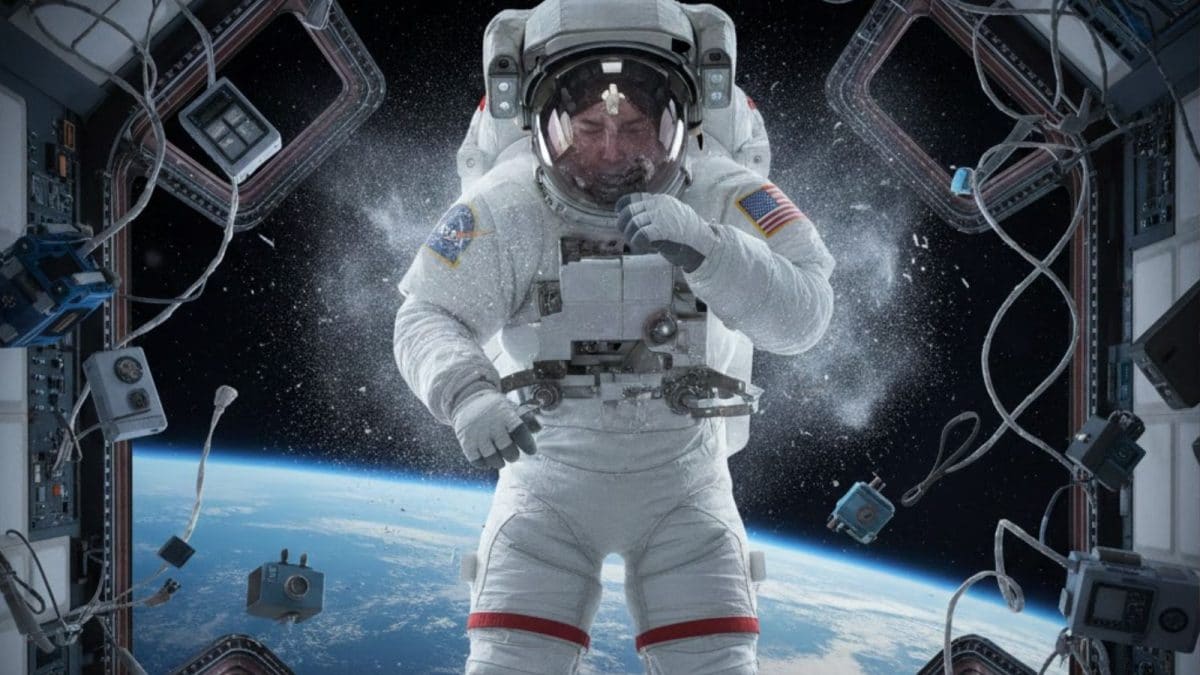
Scientists found that astronauts' brains change shape when they spend a long time in space.
The brain moves up and back in the skull because there's no gravity pulling it down like on Earth.
This can make the top of the brain get squished and the bottom get pulled up.
It can also cause problems with balance and vision.
Most of the changes go back to normal after the astronauts return to Earth, but some changes might stay.
This is important for future space trips, like going to Mars, because we need to understand how space affects the brain.

Prolonged exposure to microgravity causes astronauts' brains to shift upwards and backwards within the skull.
This brain displacement results in 'crowding' at the top of the head, compressing and stretching neural tissue.
The supplementary motor cortex, crucial for physical movement, can shift upwards by as much as 2.5 millimetres in long-duration astronauts.
These structural changes are linked to balance declines and sensory disorientation upon returning to Earth.
Some brain changes persist long after the mission ends, with implications for future space exploration, particularly missions to Mars.
- Who
- Astronauts on long-duration missions to the International Space Station (ISS)
- What
- Their brains undergo physical deformation and shifting due to prolonged exposure to microgravity
- When
- During and after space missions, with some changes persisting for months
- Where
- In space, particularly aboard the ISS
- Why
- Due to the absence of Earth's gravitational pull, causing the brain to shift upwards and backwards within the skull
- Study Journal
- Proceedings of the National Academy of Sciences (PNAS)
- Lead Researcher
- Dr Rachel Seidler
- Number of Astronauts Studied
- 26
- Control Group Size
- 24
- Brain Shift in Long-Duration Astronauts
- 2.5 millimetres
- Affected Brain Region
- Supplementary motor cortex
- Condition Linked to Brain Shifts
- Spaceflight-Associated Neuro-ocular Syndrome (SANS)