

Archive · 27 Jul 2025
Ancient Chinese Earthquake Sensor Recreated by Scientists
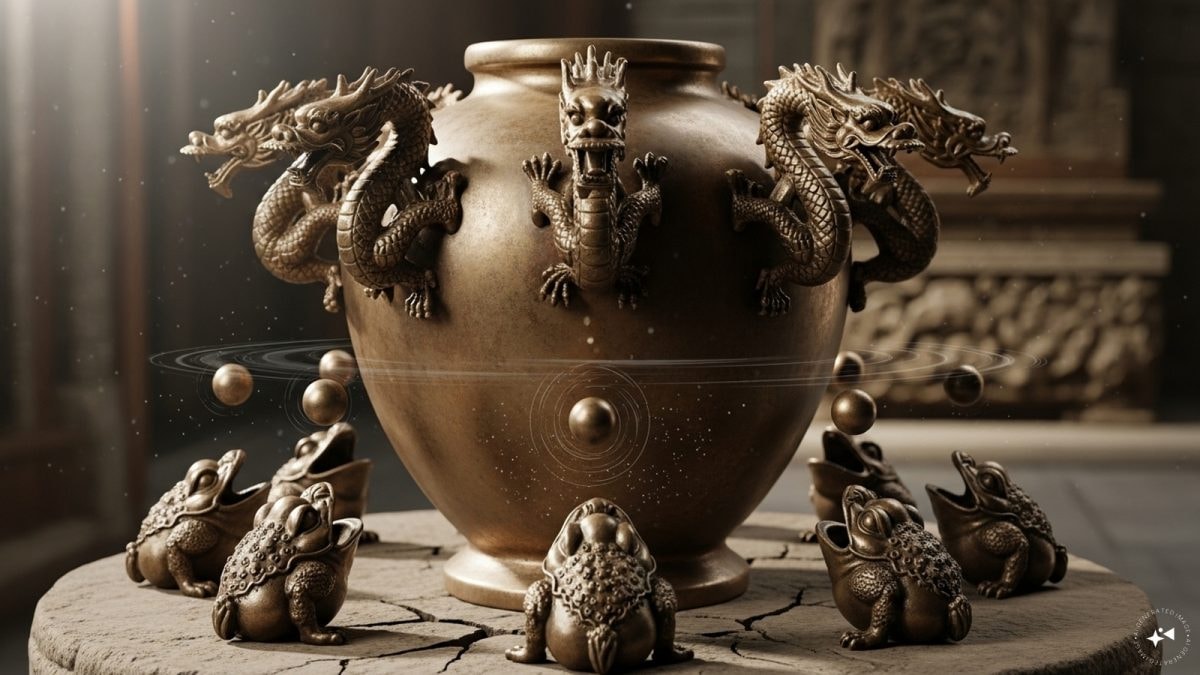
Imagine an ancient Chinese device, like a fancy jar with dragons holding balls.
When the ground shook, one dragon would drop its ball into a toad's mouth, showing the direction of an earthquake.
Created around 2,000 years ago, it was called the Houfeng Didong Yi.
Some people thought it was just a myth, but scientists in China are trying to build a real one now!
They're using smart tools to recreate how it worked, focusing on a special swinging stick to amplify the shaking.
This makes a ball drop, showing where the earthquake came from.
It's like solving a mystery from the past to see if this old device was as amazing as people said it was.

Researchers in China are recreating a 2,000-year-old earthquake sensor, the Houfeng Didong Yi.
The original device, created by Zhang Heng, was said to detect earthquake direction.
Historical texts and some scholars have debated the seismoscope's authenticity.
The new model uses modern seismic knowledge with an excitation, transmission, and shutdown system.
The device used a pendulum to amplify tremors, dropping a ball to indicate the quake's direction.
- Who
- A team of researchers in China, led by Xu Guodong, are recreating the seismoscope.
- What
- Researchers are recreating the Houfeng Didong Yi, a 2,000-year-old Chinese earthquake sensor.
- When
- The original device was created around 2,000 years ago; the recreation is ongoing.
- Where
- The research is taking place in China.
- Why
- To prove the ancient invention's authenticity and understand its engineering.
Skeptics
Proponents
Authenticity of Original Device
Skeptics
Some scholars doubted the existence of the original seismoscope, calling it a myth.
Proponents
Other people believe it was a remarkable engineering achievement.
- Device Name
- Houfeng Didong Yi
- Inventor
- Zhang Heng
- Era
- Eastern Han dynasty (132 AD)
- Purpose
- Detecting direction of earthquakes
- Modern Research Lead
- Xu Guodong
- Key Component
- Pendulum-like cantilever