

Archive · 24 Sep 2025
EPF Explained: Decoding Contributions, Pensions, and Savings
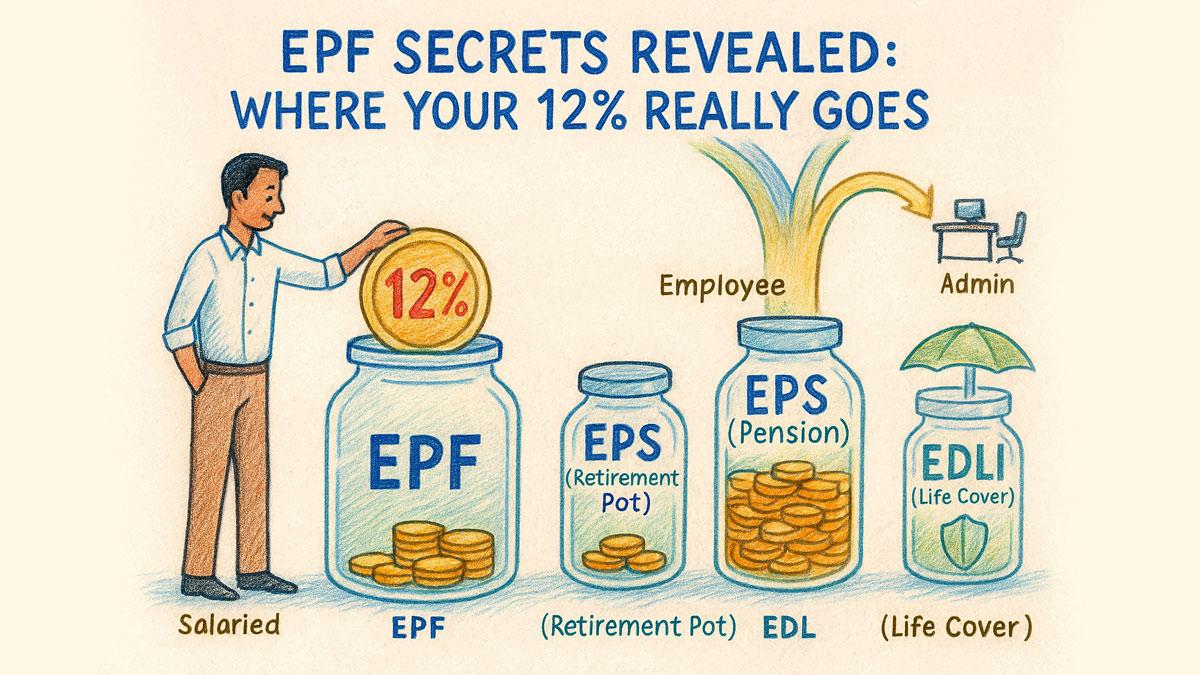
Every month, you and your employer contribute to your Employee Provident Fund (EPF).
You put in 12% of your pay.
Your employer also contributes 12%, but it's split up.
Part of your employer's share goes to your EPF, and some goes to the Employee Pension Scheme (EPS) for your future pension, to Employees' Deposit Linked Insurance (EDLI) for life cover, and to cover admin fees.
The EPS contribution is based on a salary ceiling.
If you want to save more for retirement, you can add to your EPF through the Voluntary Provident Fund (VPF).

Employees contribute 12% of basic salary plus dearness allowance (DA) to EPF.
Employers also contribute 12%, but a portion goes towards EPS (pension), EDLI (insurance), and admin charges.
EPS contributions are capped based on a salary ceiling of Rs 15,000 per month.
EPF grows with salary; however, EPS contributions are capped.
Employees can make extra voluntary contributions to EPF through VPF.
- Who
- Employees and Employers in India
- What
- Breakdown of Employee Provident Fund (EPF) contributions, including EPF, EPS, and EDLI.
- When
- Monthly contributions.
- Where
- India
- Why
- To explain how EPF contributions work and their impact on retirement and insurance benefits.
- Employee Contribution
- 12% of basic salary + DA
- Employer Contribution
- 12% of basic salary + DA (split between EPF, EPS, EDLI, and admin)
- EPS Contribution
- 8.33% of salary (capped at Rs 15,000/month)
- EDLI
- Life cover
- VPF
- Voluntary Provident Fund for extra contributions