Archive · 2 Nov 2025
Chhattisgarh HC Upholds Village Hoardings Restricting Pastors
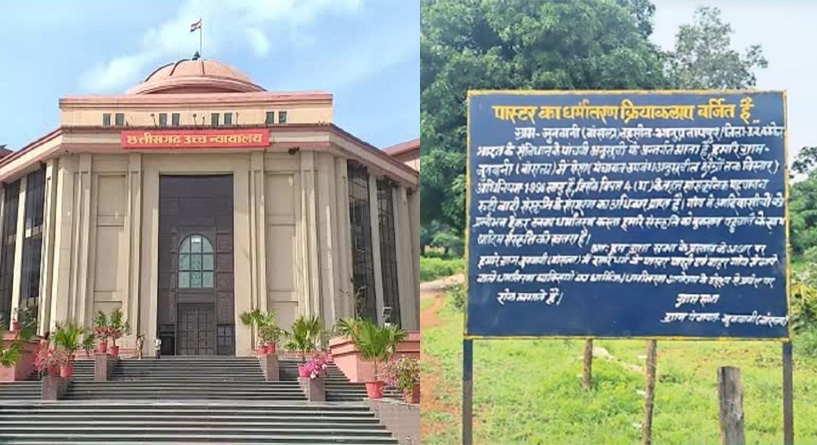
Some villages in India put up signs saying pastors and people who had changed their religion couldn't come in.
They said this was to protect their old traditions and culture.
Some people complained to the big court, saying the signs were unfair and stopped people from practicing their religion freely.
The court looked at the signs and said they were okay.
The judges explained that while people can choose their religion, it's not okay to force or trick others into changing.
These signs were just a way for the villagers to protect their ways of life, especially in areas with special rules for indigenous people.
The court also mentioned that the people who complained should have tried to fix the problem through the local village systems first.

Chhattisgarh High Court ruled that hoardings in some villages restricting pastors and 'converted Christians' are not unconstitutional.
The court stated these hoardings were likely precautionary measures by Gram Sabhas to protect tribal interests and cultural heritage.
The petitions alleged the hoardings were part of a resolution called 'Hamari Parampara Hamari Virasat' (Our Tradition, Our Heritage) to discriminate against Christians.
The court emphasized that preventing illegal conversions through force or allurements is not unconstitutional.
The High Court dismissed the petitions, suggesting that alternative legal remedies should have been pursued first.
- Who
- Chhattisgarh High Court (division bench: Chief Justice Ramesh Sinha and Justice Bibhu Datta Guru), Gram Sabhas of villages in Bastar and Kanker districts, Petitioners Digbal Dandi and Narendra Bhavani.
- What
- The Chhattisgarh High Court ruled that hoardings in some villages, restricting the entry of pastors and 'converted Christians', are not unconstitutional.
- When
- Unknown (Decision date not specified in article, ruling mentioned as recent)
- Where
- Villages in Bastar and Kanker districts, Chhattisgarh
- Why
- The court determined that the hoardings were precautionary measures by Gram Sabhas to safeguard tribal interests and cultural heritage, specifically to prevent illegal conversions by force or inducement.
Petitioners' Claims
High Court's Ruling
Nature of Hoardings
Petitioners' Claims
Hoardings and village resolutions under 'Hamari Parampara Hamari Virasat' promoted discrimination and created fear among minority communities.
High Court's Ruling
The hoardings were precautionary measures by Gram Sabhas to protect tribal interests and cultural heritage.
Constitutional Validity
Petitioners' Claims
The hoardings violated Article 25 of the constitution, which guarantees freedom of religion.
High Court's Ruling
The installation of hoardings to prevent forcible conversion by way of allurement or fraudulent means cannot be termed unconstitutional; freedom of religion is not absolute and does not permit conversion by force or inducement.
Legal Recourse
Petitioners' Claims
Petitioners sought removal of hoardings, alleging their unconstitutionality.
High Court's Ruling
Petitioners should have first exhausted the statutory alternative remedy of appealing to the sub-divisional officer (Revenue) before approaching the High Court.
- Court
- Chhattisgarh High Court (Bilaspur)
- Date of Ruling
- Unknown (Article published date implied)
- Districts Mentioned
- Kanker District, Bastar District, Chhattisgarh
- Key Slogan/Resolution
- Hamari Parampara, Hamari Virasat (Our Tradition, Our Heritage)
- Relevant Law Cited
- Panchayat Extension to Scheduled Areas Act, 1996 (PESA Act)
- Constitutional Article Mentioned
- Article 25 (Freedom of Religion)
Sources
Chhattisgarh HC upholds right of tribals to protect their culture from illegal missionary proselytization

‘Not unconstitutional’: Chhattisgarh HC upholds validity of hoardings barring entry of pastors

Hoardings Barring Pastors’ Entry Not Unconstitutional: Chhattisgarh HC