

Archive · 8 Aug 2025
Black Hole Probe: A Futuristic Quest Faces Practical Hurdles
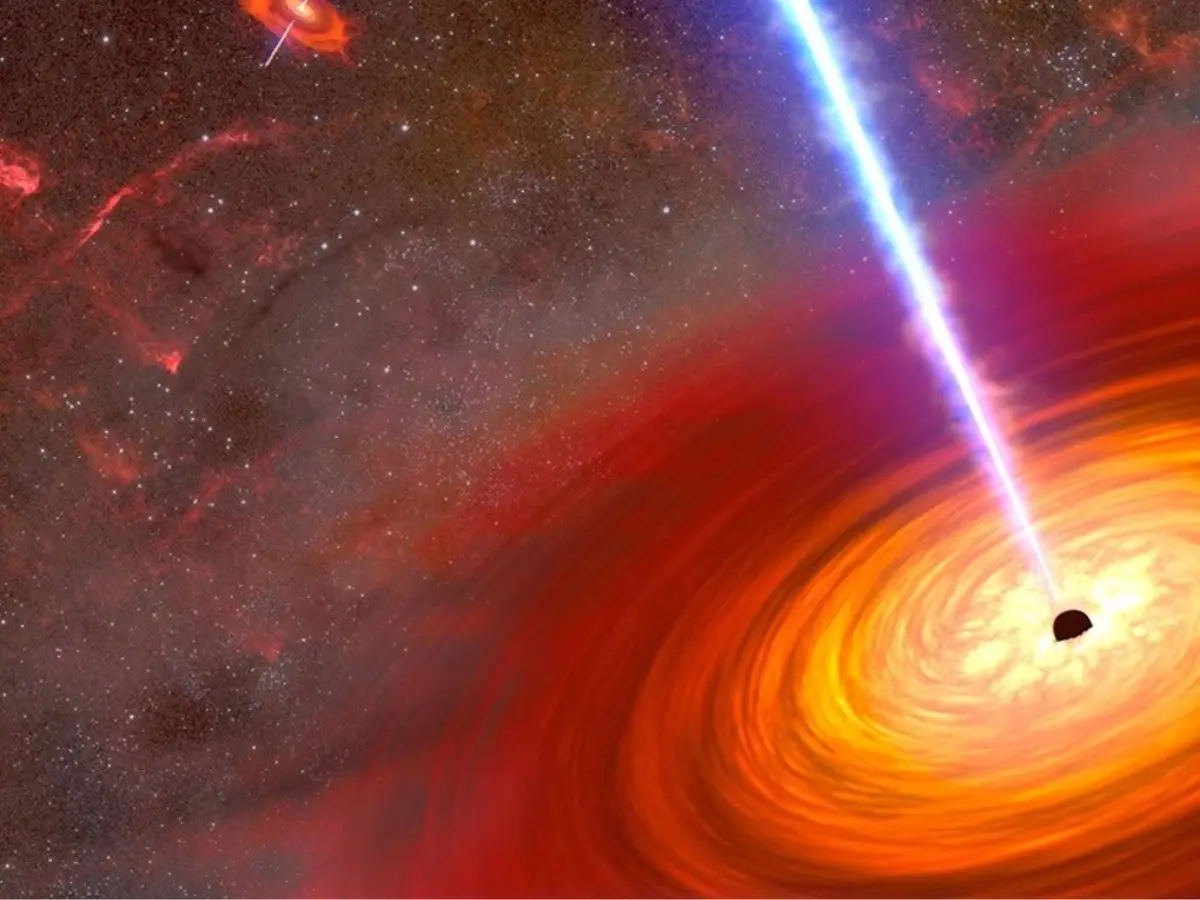
Imagine sending a tiny spaceship to a black hole to learn its secrets!
A scientist wants to do this, using a chip-sized craft pushed by lasers.
The main problem is that the technology doesn't exist yet, and it needs a black hole close enough to reach.
It would cost a lot of money and take a long time to build, travel, and send back information.
The craft would travel really fast, about one-third the speed of light, to reach its destination.
Even if we could build the spaceship today, the nearest black hole might be too far away to visit.

A scientist proposed sending a nanocraft to a black hole to study spacetime.
The mission requires developing currently non-existent technology and a suitable black hole within 20-25 light-years.
The nanocraft, smaller than a paper clip, would be propelled by lasers to a third of light speed.
The project is estimated to take 100 years, including travel and data transmission time.
The estimated cost is over $1 trillion, although future technological advancements might reduce this.
- Who
- Professor Cosimo Bambi proposed the mission.
- What
- A proposal to send a nanocraft to study a black hole.
- When
- The mission timeline is projected to be around 100 years.
- Where
- The target black hole needs to be within 20-25 light-years of Earth.
- Why
- To study the fabric of spacetime by directly probing a black hole.
The Feasibility Issues
The Potential Benefits
Cost
The Feasibility Issues
The project is currently beyond the budget of any scientific experiment.
The Potential Benefits
Future technological advancements might reduce the cost significantly.
Technology
The Feasibility Issues
The technology required does not exist and cannot be built today.
The Potential Benefits
Professor Bambi is hopeful that this can be done in the future, all it needs is "time, money, and motivation."
Distance
The Feasibility Issues
The nearest black hole may be too far away to realistically visit.
The Potential Benefits
A black hole within 20-25 light-years is necessary to make the trip viable.
- Proposed Craft Size
- Chip-sized nanocraft
- Propulsion Method
- Laser-powered sail
- Speed
- One-third the speed of light
- Estimated Mission Time
- 100 years
- Estimated Cost
- $1 trillion
- Target Distance
- Within 20-25 light-years
- Current Closest Black Hole
- Gaia-BH1, 1,560 light-years away