

Archive · 25 Jul 2026
NASA Study Reveals Mars Auroras Form Like Earth's
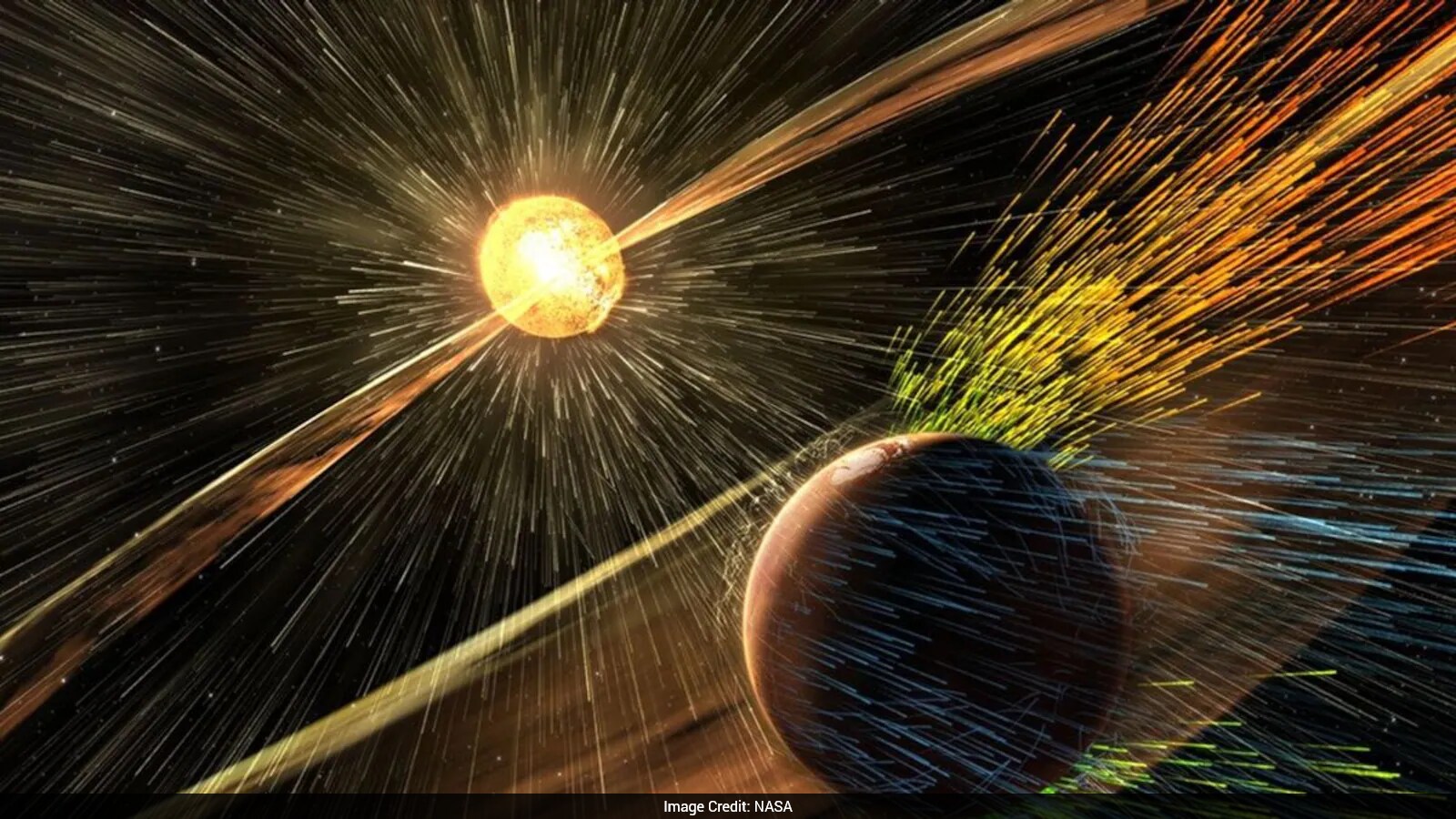
Scientists have found that Mars has auroras that form in a way similar to Earth's.
This happens when the Sun's magnetic field connects with Mars' magnetic fields, sending charged particles into the atmosphere.
Mars doesn't have a global magnetic field like Earth, but it has many small magnetic regions in its crust.
The discovery was made using data from NASA's MAVEN mission, which has now ended.
This helps scientists understand how Mars and Earth evolved differently and how the solar environment affects Mars, which is important for future missions.

NASA study finds Mars auroras form through a process similar to Earth's Dungey cycle.
Discovery based on data from the MAVEN mission, which concluded on June 3, 2026.
Mars has localized magnetic fields in its crust, unlike Earth's global magnetic field.
Scientists used instruments like the Magnetometer and STATIC to study the auroras.
The findings improve understanding of Mars' interaction with the solar environment, crucial for future missions.
- Who
- NASA scientists using data from the MAVEN mission
- What
- Discovery of a similar aurora formation process on Mars as on Earth
- When
- Study published in Nature Communications, mission concluded on June 3, 2026
- Where
- Mars
- Why
- To understand the Red Planet better and improve future missions
Scientific Discovery
Mission Conclusion
Aurora Formation
Scientific Discovery
Mars auroras form through a process similar to Earth's Dungey cycle, involving magnetic reconnection.
Mission Conclusion
The discovery was made using data from the MAVEN mission, which has concluded.
- Study Published
- Nature Communications
- Mission Name
- MAVEN (Mars Atmosphere and Volatile Evolution)
- Mission Conclusion Date
- June 3, 2026
- Lead Author
- Shaosui Xu
- Principal Investigator
- Shannon Curry
- Key Instruments Used
- Magnetometer, Solar Wind Electron Analyzer, STATIC