8 hrs ago
Crude Surges Above $100, Putting Five Sectors Under Pressure
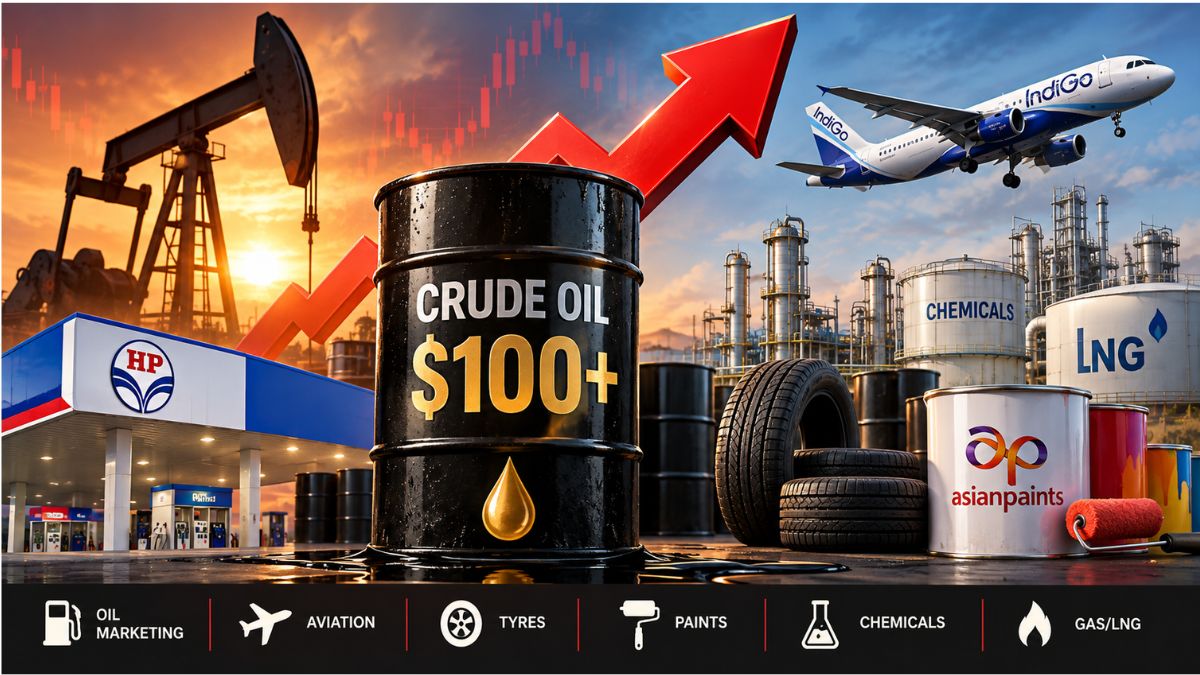
Oil prices have climbed above $100 for each barrel of crude oil.
This makes it more expensive for many companies to operate.
Oil retailers such as HPCL, IOC and BPCL may have to pay more for crude while keeping petrol and diesel prices unchanged.
Analysts say HPCL could face the greatest pressure among these companies.
Airlines may spend more on jet fuel, which is a large part of their costs.
Tyre and paint companies may pay more for petroleum-based materials.
Chemical and gas companies may also face higher costs for feedstocks or LNG.
The final impact will depend on how long oil stays expensive and whether companies can raise their prices.

Brent crude rose above $100 a barrel, reaching nearly $108 after fresh supply-disruption concerns.
Oil marketing companies face the most immediate earnings risk because retail fuel prices may not keep pace with crude costs.
Analysts identify HPCL as the most vulnerable major oil marketer, followed by IOC and BPCL.
Airlines, tyre makers and paint manufacturers face higher fuel or petroleum-linked input costs that could reduce margins.
Specialty chemicals, gas-linked companies and lubricant businesses may also face feedstock, LNG or crude-derivative cost pressure.
- Who
- Oil marketing companies, airlines, tyre makers, paint manufacturers, specialty chemical companies and gas-linked businesses.
- What
- A surge in crude oil prices is threatening margins and earnings across several sectors.
- Where
- The impact is focused on companies operating in India, while supply concerns involve Saudi Arabia and Gulf shipping.
- When
- Brent crude rose more than 30% from early-July levels and traded near $108 a barrel on Monday.
- Why
- Higher crude raises fuel, raw-material, LNG, freight, insurance and working-capital costs, while companies may not be able to pass the increases fully to customers.
Cost Pass-Through
Margin Compression
Who absorbs higher costs?
Cost Pass-Through
Companies may limit the damage if they can raise fuel, product or service prices, reduce costs, or benefit from favorable refining and trading conditions.
Margin Compression
If retail prices and selling prices remain unchanged, higher crude, LNG and petroleum-linked input costs could sharply reduce margins and earnings.
Oil marketing exposure
Cost Pass-Through
The impact on HPCL, IOC and BPCL will depend on government policy, retail-price adjustments, refining margins and the duration of the price surge.
Margin Compression
If crude remains above $100 while petrol, diesel and LPG prices are held down, marketing margins could turn negative and working-capital needs could rise.
Company vulnerability
Cost Pass-Through
Diversification, internal refining capacity, gas trading and transmission earnings can provide some protection for individual companies.
Margin Compression
HPCL's lower refining-to-marketing ratio and smaller diversification were cited as reasons it could be more vulnerable than IOC and BPCL.
Key facts
- Brent price
- Nearly $108 a barrel on Monday; it had reached $109.97 on September 11.
- Recent increase
- Brent was up more than 30% from early-July levels.
- Most exposed sector
- Oil marketing companies, including HPCL, IOC and BPCL.
- Most vulnerable marketer
- Analysts identified HPCL as the most exposed, followed by IOC and BPCL.
- Airline cost exposure
- Air turbine fuel accounts for around 35-50% of airlines' operating costs, according to one analyst.
- Paint input exposure
- Crude-derived inputs can represent roughly 35-45% of paint raw-material costs.
- Key uncertainty
- The earnings impact depends on how long crude stays elevated and how much cost companies can pass through.
Quotes
Sunny Agrawal
Deputy Vice President of Fundamental Research at SBI Securities
“If you look at the near term, crude oil price is negative for oil marketing companies because the retail price is fixed, but crude price, which is a key raw material for oil marketing companies, has already touched $100. Definitely, it is negative for oil marketing companies.”
 financialexpress.com
“Impact depends primarily on retail-price pass-through, gov policies and refining cracks. If crude remains elevated while petrol, diesel and LPG prices are held unchanged, OMCs would face greatest direct pressure, with vulnerability ranking at: HPCL > IOCL > BPCL.”
financialexpress.com
Sources
Related news
Rising Crude Prices Deepen Losses for India’s Oil Marketers
Brent Crude Surges Above $100, Pressuring Indian Fuel Marketers
Crude Spike Unlikely to Trigger Immediate Indian Fuel Hike
Oil Stocks Rise as Brent Crude Nears $100 Amid Tensions

ONGC, Oil India Rise as Brent Crude Tops $100
India’s Crude Basket Tops $100 as Geopolitical Risks Persist

India’s Sustainable Packaging Startups Shift Toward Commercial Scale

Ola Electric Appoints New CFO Amid Market Challenges
BP Sells 65% Stake in Castrol
Delhi Police Bust Multiple Crime Syndicates