

Archive · 21 May 2025
James Webb Telescope Discovers Ancient Galaxy Resembling the Milky Way
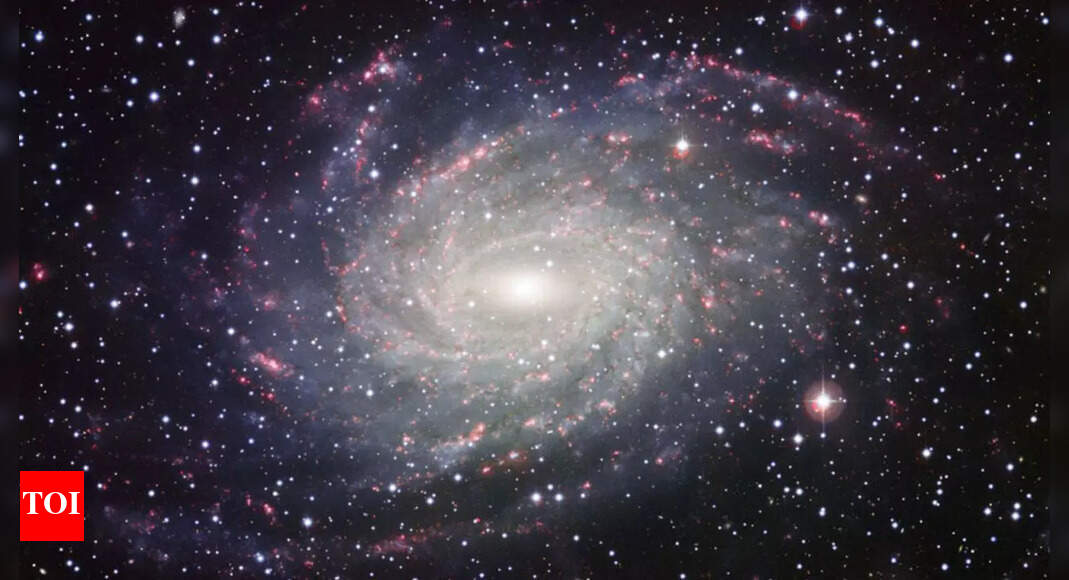
Imagine the universe was a baby a long time ago.
Scientists have found a galaxy called Zhúlóng that looks a lot like our own Milky Way, but it's super old!
This galaxy existed just a billion years after the Big Bang.
It's a spiral, just like ours, which is surprising because scientists thought these types of galaxies took much longer to form.
Zhúlóng shows us that galaxies could have grown up much faster than we thought.
It helps scientists understand how galaxies like ours got their shape and size so early in the universe, and helps answer questions about the Big Bang.

Astronomers discovered Zhúlóng, a spiral galaxy from 12.8 billion years ago.
Zhúlóng has a structure similar to the Milky Way.
The galaxy's size is approximately 62,000 light-years in diameter, and comparable in stellar mass to the Milky Way.
The discovery challenges existing theories of galaxy formation.
Zhúlóng’s rapid evolution offers a new benchmark for understanding the early universe.
- Who
- Astronomers using the James Webb Space Telescope.
- What
- The discovery of Zhúlóng, a spiral galaxy.
- When
- Zhúlóng existed 12.8 billion years ago, within the first billion years after the Big Bang.
- Where
- Observed in the early universe, far away from Earth.
- Why
- To understand how galaxies formed in the early universe.
- Galaxy Name
- Zhúlóng
- Age
- 12.8 billion years old
- Diameter
- 62,000 light-years
- Stellar Mass
- Comparable to Milky Way
- Telescope
- James Webb Space Telescope
- Research Published In
- Astronomy & Astrophysics
- Star Formation Rate
- 20 to 155 solar masses per year