

Archive · 21 Jan 2026
Webb Telescope Reveals Dead Star's Core
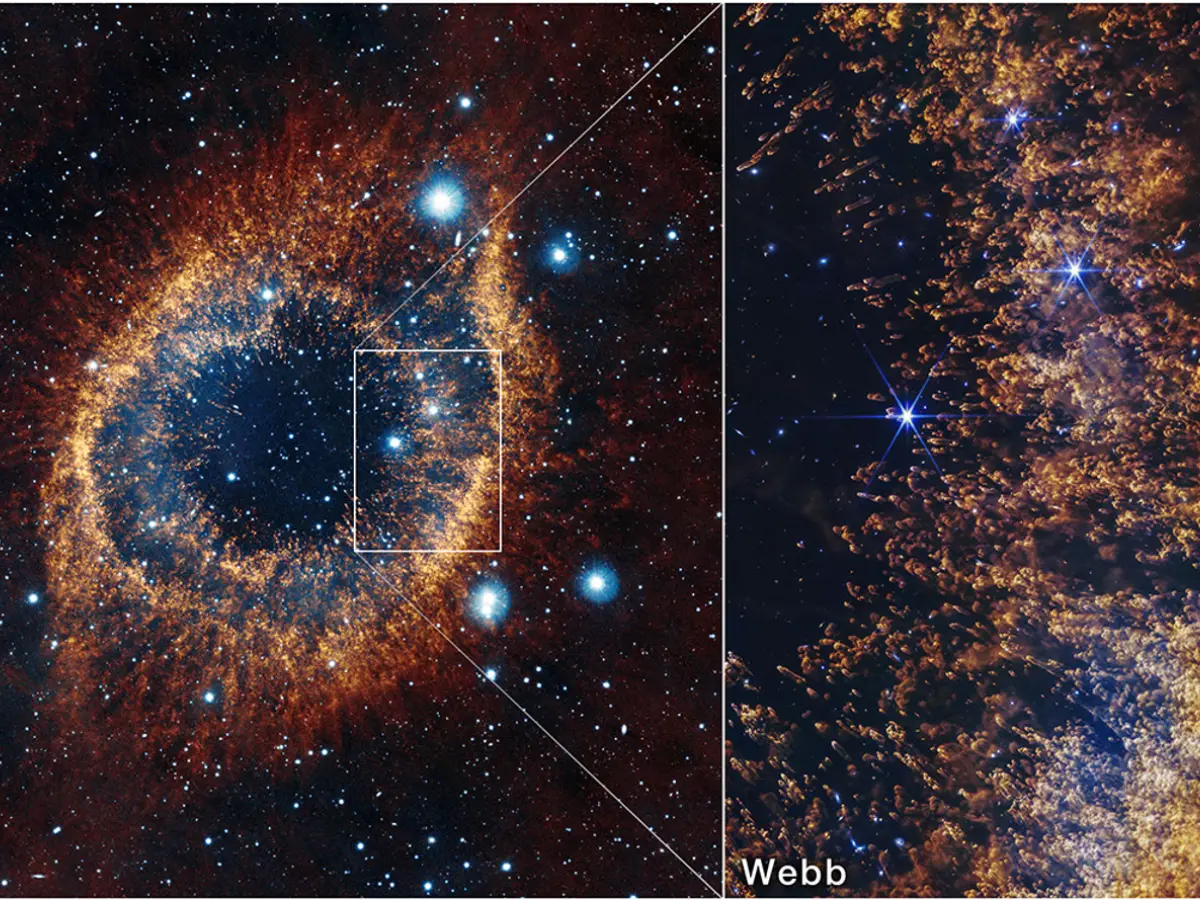
The James Webb Space Telescope has taken a detailed look at the Helix Nebula, also known as the Eye of Sauron or Eye of God.
This nebula is made up of layers of gas and dust that were shed by a dying star.
At the center of the nebula, there is a white dwarf, which is the core of the dead star.
This white dwarf is very bright and is releasing hot material that collides with the cooler gas and dust around it.
The interaction between the hot and cold gas gives the nebula its unique shape.
The material being released by the white dwarf will eventually form new planets and stars.
This process is similar to what will happen to our Sun billions of years from now.
The telescope's Near-Infrared Camera (NIRCam) captured detailed images of the nebula, revealing comet-like knots and cloudy pillars that look like flames.
The nebula's unique shape comes from how the hot gas interacts with the cold shell of gas and dust.

The James Webb Space Telescope observed the Helix Nebula, revealing its layers of gas and dust.
At the core of the nebula is a white dwarf, the remnant of a dead star, shedding hot material.
The interaction between hot and cold gas gives the nebula its unique shape, resembling the Eye of Sauron.
The material released by the white dwarf will form new planets and stars in the future.
The telescope's NIRCam captured detailed images, showing comet-like knots and cloudy pillars.
- Who
- James Webb Space Telescope
- What
- Observation of the Helix Nebula and its white dwarf core
- When
- Not specified
- Where
- Helix Nebula in space
- Why
- To study the remnants of a dying star and the formation of new celestial bodies
- Nebula Name
- Helix Nebula
- Telescope Used
- James Webb Space Telescope
- Star Remnant
- White Dwarf
- Nebula Nicknames
- Eye of Sauron, Eye of God
- Key Feature
- Layers of gas and dust
- Future Implications
- Source for new planets and stars
- Camera Used
- NIRCam (Near-Infrared Camera)
- Unique Shape Cause
- Interaction of hot and cold gas