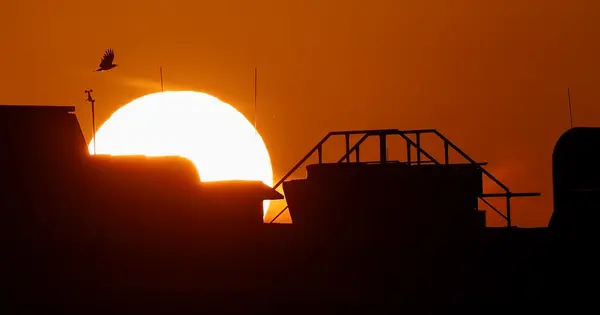
Archive · 19 Jun 2025
Summer Solstice: Longest Day of the Year in the Northern Hemisphere

The summer solstice is the longest day of the year for the Northern Hemisphere, happening when Earth tilts closest to the sun.
This gives us more daylight.
Cultures worldwide celebrate it with rituals.
Farmers use it to plan crops, using the long sunlight hours for growth.
It's a time of high energy and renewal.

Summer solstice marks the longest day and shortest night of the year in the Northern Hemisphere.
It occurs when the Earth's axial tilt is most inclined towards the sun.
The solstice is an astronomical milestone with cultural and spiritual significance.
Many cultures have celebrated the solstice for centuries, with rituals and gatherings.
It is significant for agriculture, guiding planting and harvesting due to longer daylight.
- Who
- Occurs for those in the Northern Hemisphere.
- What
- The longest day of the year and start of summer in the Northern Hemisphere.
- When
- Around June 20 or 21, in 2025 it is June 21.
- Where
- Northern Hemisphere.
- Why
- Due to Earth's axial tilt towards the sun.
Scientific Perspective
Cultural and Spiritual Perspective
Importance
Scientific Perspective
The Earth's axial tilt is key to understand seasons
Cultural and Spiritual Perspective
Summer Solstice is celebrated in many ways around the world.
- Event
- Summer Solstice
- Hemisphere
- Northern Hemisphere
- Date
- June 21, 2025
- Cause
- Earth's axial tilt
- Significance
- Marks the longest day, start of summer, and is culturally significant