

Archive · 2 Jul 2025
Study Links Air Pollution Exposure to Increased Heart Risk
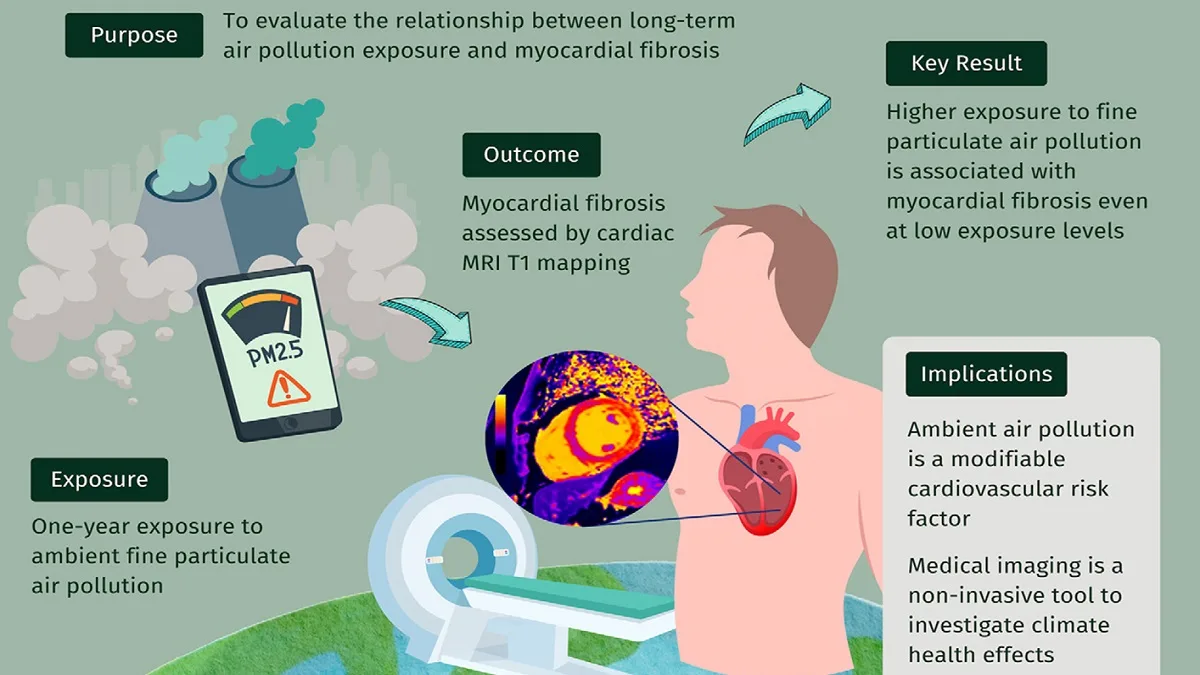
Imagine your heart is like a strong engine, and tiny pollution particles are like sand that can damage the engine over time.
This study found that even small amounts of this pollution can hurt the heart muscle, causing it to scar.
When the heart muscle scars, it can't pump blood as well, which can lead to serious problems like heart failure.
The researchers looked at people's hearts using special scans and found damage even when the pollution levels were considered safe.
This damage was seen in everyone, but especially in women, smokers, and those with high blood pressure.
The pollution comes from things like cars, factories, and wildfires, and the study highlights a serious problem.

Study links long-term exposure to PM2.5 to myocardial fibrosis, a heart muscle scarring.
Damage was observed at PM2.5 levels below global safety guidelines.
Researchers analyzed cardiac MRI scans of nearly 700 subjects in Toronto.
Myocardial fibrosis can weaken the heart and lead to heart failure.
Women, smokers, and those with hypertension showed the largest effects.
- Who
- Researchers from the University of Toronto
- What
- Study found a link between long-term PM2.5 exposure and myocardial fibrosis.
- When
- Study published Tuesday in the journal Radiology, MRI scans conducted between January 2018 and December 2022.
- Where
- Toronto, Canada
- Why
- To understand the underlying changes in the heart muscle resulting from constant exposure to air pollution.
- Study Focus
- Impact of PM2.5 on heart health
- PM2.5 Level (Study)
- 7.7 micrograms per cubic meter
- Participants
- Approximately 700 subjects
- Method
- Cardiac MRI scans
- Primary Issue
- Myocardial fibrosis
- Common Sources of PM2.5
- Vehicular exhaust, industrial emissions, and wildfire smoke