

Archive · 16 Jan 2026
Indian scientists discover rare subterranean amphibian species
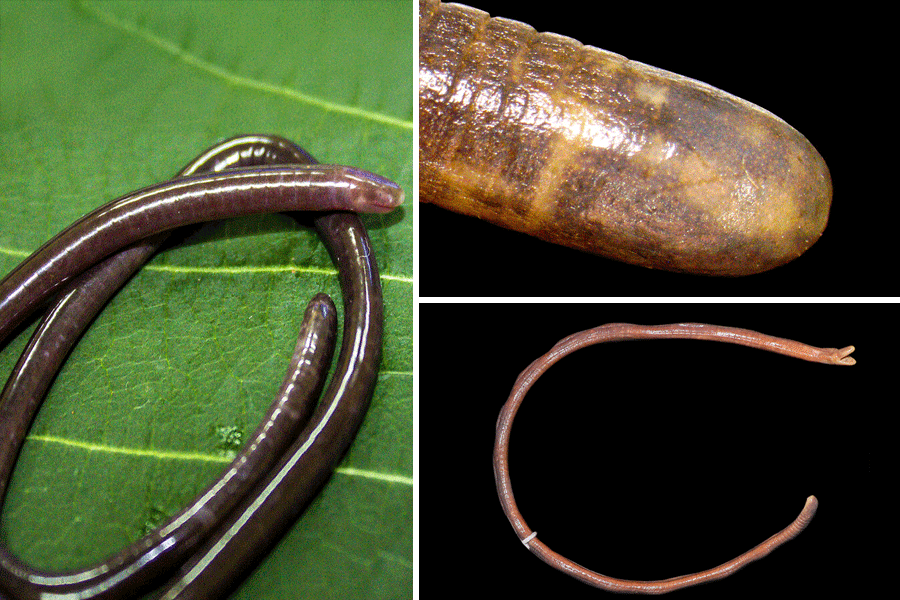
Indian scientists have found a new kind of amphibian that lives underground.
It's called Gegeneophis valmiki and was discovered in the Western Ghats of Maharashtra.
This amphibian is part of a group called caecilians, which are like worms and very hard to find.
They don't have visible eyes and don't make sounds like frogs.
The scientists named it after a nearby temple to honor the local area.
This discovery is important because it helps us learn more about the animals that live in the soil and how they help the environment.
There are many more species like this that we don't know about yet, and scientists are working to find and protect them before they disappear.

Indian scientists discovered a new subterranean amphibian species, Gegeneophis valmiki, in the Western Ghats of Maharashtra.
The species was first collected in 2017 and formally described after years of study.
Gegeneophis valmiki is the first addition to its genus in over a decade.
Caecilians, like the newly discovered species, are limbless, worm-like creatures that spend most of their lives underground.
The discovery highlights the importance of documenting and conserving rare and lesser-known species to prevent 'silent extinctions'.
- Who
- Indian scientists led by Dr. K.P. Dinesh
- What
- Discovered a new subterranean amphibian species, Gegeneophis valmiki
- When
- First collected in 2017, formally described recently
- Where
- Valmiki Plateau in Satara district, Maharashtra
- Why
- To document and understand India's biodiversity, especially rare and lesser-known species
- Species Name
- Gegeneophis valmiki
- Discovery Location
- Valmiki Plateau, Satara district, Maharashtra
- Discovery Year
- 2017
- Research Journal
- Phyllomedusa
- Global Amphibian Species
- 8,983
- Indian Amphibian Species
- 457
- Indian Caecilian Species
- 42
- Western Ghats Endemic Caecilians
- 26