1 hr ago
How Hindutva and Sanatana Dharma Became Politically Entangled
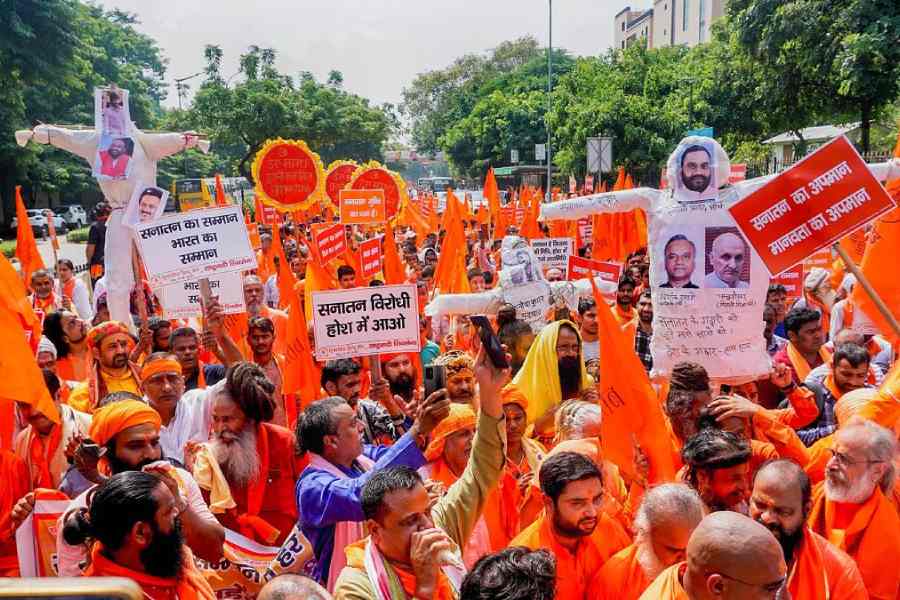
The article says Sanatana Dharma and Hindutva are not the same thing.
Sanatana Dharma is a broad tradition with many beliefs and practices.
Hindutva is a political idea that grew in the twentieth century.
Vinayak Damodar Savarkar described Hindutva as a shared national and cultural identity, not simply a religion.
The article says he sometimes worked with orthodox Sanatani groups for political reasons.
It argues that today’s BJP and RSS more often connect the two ideas.
The author says this can make a diverse tradition seem like one political identity.
The article also raises concerns about caste, social reform and the exclusion of people whose holy lands are outside India.
Its central argument is that politics, rather than an inherent connection, has brought the terms together.

The article distinguishes Sanatana Dharma, a diverse religious and civilisational tradition, from Hindutva, a modern political ideology.
It says Vinayak Damodar Savarkar defined Hindutva in 1923 around shared nation, race and civilisation, rather than religion alone.
The article describes Savarkar’s relationship with Sanatani orthodoxy as a pragmatic alliance, citing a 1941 compromise over temple-entry legislation.
It argues that the BJP and Rashtriya Swayamsevak Sangh increasingly connect Sanatana Dharma with Hindu nationalism, unlike Savarkar’s stated distinction.
The author contends that this political merging can lend Hindutva ancient legitimacy while sidelining pluralism and debates over caste and reform.
- Who
- The article discusses Sanatanis, Hindutva proponents, Vinayak Damodar Savarkar, B.R. Ambedkar, the BJP and the RSS.
- What
- It argues that contemporary politics has increasingly merged Sanatana Dharma with Hindutva, despite their distinct meanings and histories.
- Where
- India.
- When
- It refers to Hindutva’s formulation in 1923, a meeting in 1941, and contemporary Indian politics.
- Why
- The author says the fusion can give Hindutva an aura of ancient legitimacy and support a majoritarian political agenda.
Article’s critical view
Political and ideological rationale described
Relationship between the traditions
Article’s critical view
The article argues that Sanatana Dharma and Hindutva have distinct origins and that treating them as identical is a political fusion.
Political and ideological rationale described
The article describes Hindutva as an effort to unite diverse groups through a shared political and civilisational identity.
Caste and social reform
Article’s critical view
The author warns that alliances with Sanatani orthodoxy can preserve social hierarchies and undermine reform.
Political and ideological rationale described
The article says Savarkar opposed caste discrimination as a barrier to Hindu society, while also recounting his compromise with orthodox groups in 1941.
Political use of Sanatana Dharma
Article’s critical view
The author says linking the tradition to Hindutva can reduce its diversity and support majoritarian politics.
Political and ideological rationale described
The article reports that BJP and RSS figures connect Sanatana Dharma with a Hindu national identity and its revival.
Key facts
- Article author
- Bidyut Chakrabarty, identified as a former vice-chancellor of Visva-Bharati, Santiniketan
- Hindutva formulation
- Conceptualised by Vinayak Damodar Savarkar in 1923
- Savarkar’s book
- Hindutva: Who is a Hindu?
- Hindutva’s stated elements
- A shared nation (rashtra), race (jati) and civilisation (sanskriti)
- Historical episode cited
- At a 1941 meeting with a Sanatana Dharma group, Savarkar agreed not to pursue legislation on temple entry for untouchables, according to the article.
- Modern organisations discussed
- The Bharatiya Janata Party and the Rashtriya Swayamsevak Sangh
Quotes

Vinayak Damodar Savarkar
Political thinker who conceptualised Hindutva.
“Hindutva is not identical with Hindu Dharma, nor is Hindu Dharma identical with Hinduism”
 telegraphindia.com
“Hindutva is not identical with what is vaguely indicated by the term Hinduism”
telegraphindia.com
Sources
Related news

Yogi Adityanath Rebukes Hamid Ansari Over Hindu Nationalism Remarks
VCK Minister's Periyar Remarks Prompt BJP Rebuke, TVK Distancing
RSS Chief Bhagwat Says British Hindus’ Loyalties Lie With UK
Former CBI Director Nageshwar Rao Takes Sarvajan Sanatan Party Role
Indian Express, VHP Clash Over Muslim Participation in Navaratri
Mohan Bhagwat Hails Gen Z Discussion of Dharm Beyond Religion
Malda Zilla Parishad Factions Trade Claims Ahead of Leadership Election
BJP Pivots to Development Pitch in Rejinagar Bypoll
Shivakumar Leaves Form 7 Voter Deletion Probe to Election Commission

Tavleen Singh Says India Needs Political Change Now